
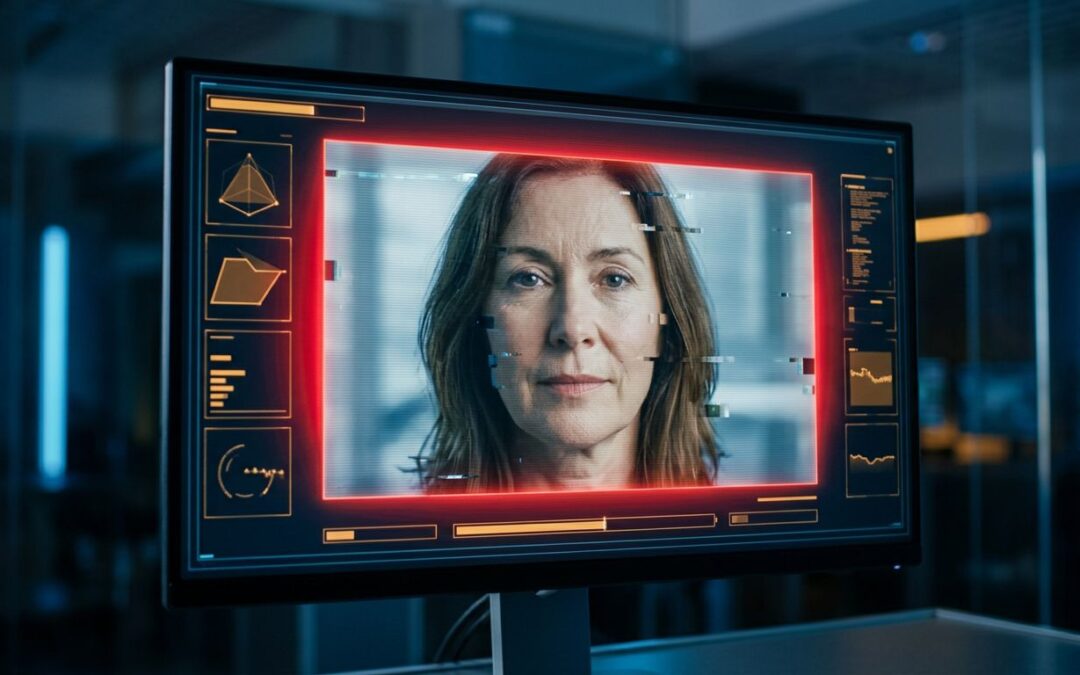
A real video can trigger an AI deepfake detector because the system interprets suspicious pixels as synthetic media, rather than understanding the full story. Factors such as heavy compression, unique lighting conditions, internal camera processing, post-production editing, and even unfamiliar facial structures can all mimic the patterns of synthetic manipulation.
That is the inherent danger behind deepfake detection false positives. While a technical score can help teams decide which files to investigate, it cannot definitively establish that a video is fake. Because these systems are prone to errors, organizations need to combine automated analysis with source records, technical reviews, contextual research, and expert human judgment before making a serious claim about the authenticity of any footage.
Key Takeaways
- Detectors search for patterns linked to manipulated media, rather than verifying the truth of the footage itself.
- Real camera footage can often contain the same technical artifacts that detection models associate with deepfakes.
- Confidence scores are influenced by detection thresholds, the quality of training data, and the environmental conditions of the video.
- Always account for false negatives in your workflow, as a clean result does not provide a definitive guarantee of authenticity.
- Human review processes should examine provenance, original file metadata, post-production edits, and independent corroborating evidence.
Why Real Footage Can Look Artificial
Deepfake tools do not watch a video as we do. Instead, detection systems analyze complex signals across frames, faces, voices, and metadata, specifically searching for the mathematical fingerprints left by generative adversarial networks or diffusion models. Some systems inspect skin texture, eye reflections, lighting, lip movement, or the edges around a face. Others study audio patterns, compression history, or movement over time.
These clues can be useful. They can also mislead.
A smartphone may apply sharpening, noise reduction, high dynamic range processing, and face smoothing before a video reaches its final file. A low-light recording can produce blotchy skin, unstable shadows, and blurred facial boundaries. A livestream may drop frames or change resolution during transmission. None of those technical artifacts proves synthetic media generation.
The problem gets worse after distribution. Social platforms re-encode uploaded videos. Messaging services may reduce quality. Screen recordings add another layer of compression. A real interview downloaded from a platform may look nothing like the original camera file.
A detector trained on clean examples can treat those changes as suspicious. Its model has learned that certain visual patterns often appear in manipulated footage, but it has not learned the complete chain of events that created the file. Even subtle digital noise can be misinterpreted as evidence of manipulation.
A detector identifies signs associated with deepfakes. It does not establish who recorded the video, when it was recorded, or whether the event happened.
We also need to separate different questions. Is the video generated? Was a real face replaced? Was the voice altered? Was the video cropped or color-corrected? Sometimes, legitimate compression artifacts are mistaken for lip sync inconsistencies, leading to a false sense of alarm. Furthermore, is the file authentic, but the caption false? These are different claims. One score cannot answer all of them.
How Detection Scores Become Accusations
Most detection systems produce confidence scores. That score may combine several model outputs, including frame-level analysis, temporal movement, audio review, and metadata. Some tools return a percentage, while others provide labels such as "likely fake" or "likely real."
A percentage can look precise without being a reliable probability. Unless the system has been properly calibrated on footage that matches our case, a score of 85 does not mean there is an 85 percent chance that the video is fake.
The threshold creates another problem because most systems perform binary classification, which categorizes a file as either synthetic or authentic. A platform may flag anything above 60 to catch more suspicious files, while a newsroom may use a higher threshold to reduce wrongful accusations. Lowering the threshold can reduce false negatives, but it usually increases false positives. Raising it can reduce false alarms while allowing more manipulated videos through.
This is a policy choice, not a discovery of objective truth.
A 2026 study available through PubMed Central's deepfake research examined how humans and machines respond to real and synthetic videos. Its subject serves as a warning against treating detection as a simple technical contest, especially as lawmakers consider how these systems align with emerging state AI laws. Performance depends on the material, the task, and the confidence attached to the decision.
We should ask four questions before reading a score:
- What kind of manipulation was the tool trained to detect?
- Was the tested file compressed, cropped, resized, or screen-recorded?
- Has the system been tested on similar people, cameras, languages, and environments?
- What threshold produced the result?
Without those answers, a score is an investigative lead. It is not a verdict.
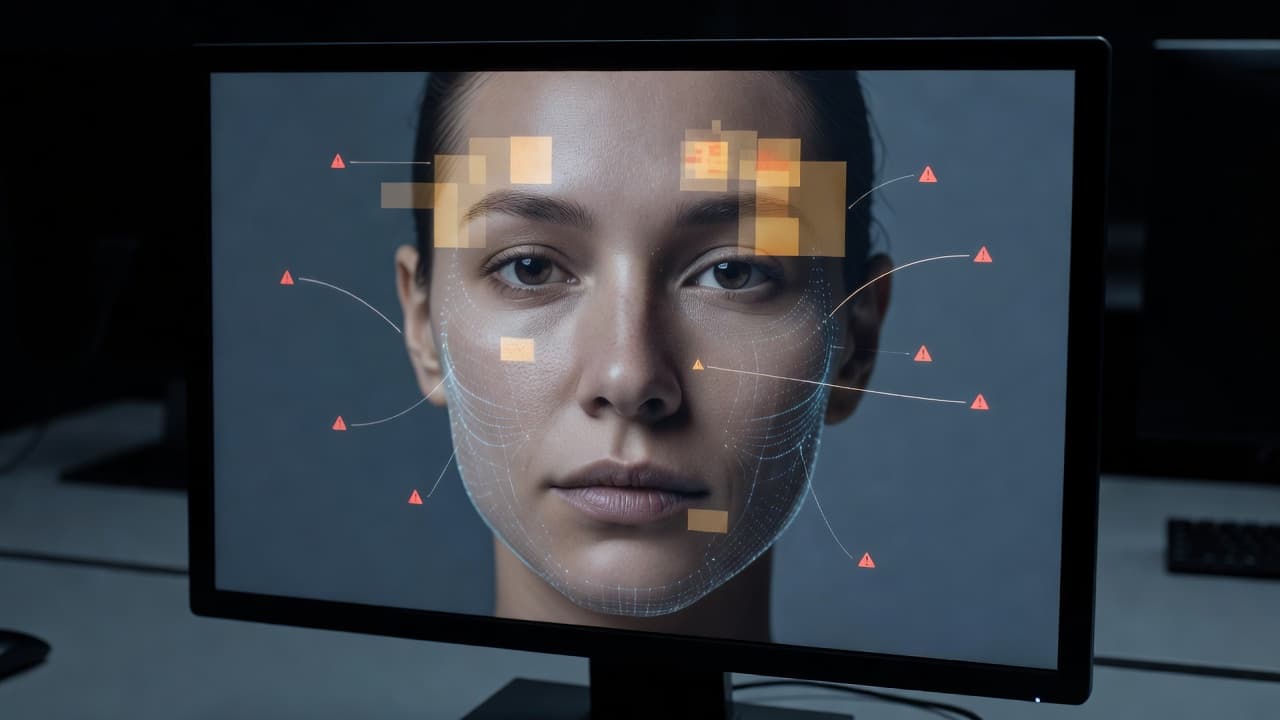
Common Causes of Deepfake Detection False Positives
Camera processing creates suspicious patterns
Modern cameras do not preserve every scene exactly as captured. Their image signal processors adjust exposure, contrast, color, sharpness, and noise. Phones may smooth faces or merge multiple exposures into one image, which can disrupt biological signal detection.
Those changes can create hard edges, unusual textures, or inconsistent detail around a face. A detector may read these subtle variations in skin texture and eye reflections as evidence of face replacement. The camera has not created a deepfake, but it has created a processed image that mimics the artifacts models look for.
This issue is especially common when we compare a sharp face with a blurred background. Portrait modes, variable lenses, and digital zoom can produce natural resolution differences that confuse automated analysis, leading to false positives.
Video compression artifacts destroy the evidence models expect
A detector often depends on tiny signals to identify manipulation. Re-encoding a video can weaken those signals or replace them with new, misleading noise. Video compression artifacts like blocking, ringing, color banding, and frame loss can look like signs of synthetic tampering to a machine learning model.
A published evaluation of deepfake detection tools identifies how compression and small visual anomalies cause real videos to be misclassified. The practical point is simple: the same video can receive different results after upload, download, cropping, or conversion. A journalist testing a social media copy is not always testing the source file, and that distinction must be included in every verification record.
Natural movement looks inconsistent at low quality
Faces move in complex ways that are difficult to capture perfectly. People blink at different speeds, glasses reflect light, and hair often crosses the forehead. When a speaker turns toward a window, one side of the face becomes darker, and low frame rates can make these movements appear as flicker or jitter.
Motion blur can soften the mouth while leaving the eyes sharp, leading a detector to flag the video for a lip-sync problem or temporal inconsistency. The same issue affects audio. Echo, background noise, automatic gain control, and a poor microphone can make a genuine voice sound altered. In many cases, a real speaker recorded in a large, hollow room may produce spectral patterns that a model associates with AI voice cloning, causing it to misidentify authentic audio as synthetic.
Training data leaves gaps
Models learn from specific examples. If their training datasets contain limited camera types, environments, languages, faces, or manipulation methods, their performance will suffer when faced with real-world variables.
This often results in demographic bias, where performance varies significantly across different groups based on age, gender, or skin tone. We should not assume that laboratory results apply equally to every real-world file. A model trained on studio footage may struggle with a street interview, and a system built primarily to detect face swaps may misread a video featuring only minor audio edits.
The legal stakes are high. A 2025 legal analysis of deepfake detection warns that overly broad automated systems can misclassify lawful content as illegal or manipulated material. For platforms and compliance teams, a false positive can mean account action, delayed publication, or a damaging accusation that is difficult to defend.
False Negatives Make a Clean Result Unsafe
While false positives receive significant attention because they can wrongly damage a person or story, false negatives create the opposite failure. In these instances, manipulated content passes as authentic, leaving security teams and journalists vulnerable to deceptive practices. These false negatives represent a dangerous gap in detection capabilities that can undermine the integrity of the entire verification process.
A detector may miss a new generation method because its training data contains older artifacts. It may fail when a manipulated file is compressed, cropped, or mixed with ordinary footage. Furthermore, a convincing piece of synthetic media may avoid the visible cues that a particular tool measures, allowing it to bypass security filters entirely.
This is why competing detectors can disagree. One may inspect face boundaries. Another may focus on voice patterns. A third may examine metadata. Their outputs are not interchangeable, and agreement still does not prove authenticity.
We should also avoid a common category error. A video can be genuine but misleading. It may show a real event from another year, a real person making a different statement, or a real clip with a false translation. Deepfake detection will not resolve those specific claims.
Media provenance remains separate work. We need the earliest available upload, the original file when possible, matching footage from independent sources, and a clear timeline. Reverse image or video searches can help locate earlier versions, but an absence of results does not prove the clip is new or authentic.
For legal and editorial decisions, we should record uncertainty instead of hiding it behind a number. "The tool flagged the file" is a factual statement. "The video is fake" is a much stronger claim.
A Safer Review Process for Newsrooms and Security Teams
Human review should not mean trusting our instincts. It should mean asking structured questions and preserving the evidence behind the decision.
First, keep the file under review. Record its URL, download time, platform, filename, format, resolution, frame rate, and hash when the workflow allows it. Save screenshots of the post and its caption, as the original source may disappear after a takedown or account change.
Next, test the file in context. Check whether the platform re-encoded it. Compare multiple copies. Look for cuts, missing frames, audio drift, abrupt changes in lighting, or edits that the detector may confuse with generation. Ask whether the suspicious region appears throughout the video or only in a few damaged frames.
Then examine provenance. Who first published the clip? Does that account have a credible connection to the event? Are there contemporaneous photos, livestreams, official records, or witnesses? When investigating, always check the digital footprints of the source to verify their history. Do independent recordings show the same location, weather, clothing, and sequence of events?
Use detection tools as one layer in that review. While real-time detection and liveness detection are helpful for identifying threats, they must be used as part of a broader strategy. Remember that repeated scores from tools trained on similar data are not independent confirmation. For security teams, this is vital when assessing executive impersonation fraud and business email compromise, which are often the end goals of sophisticated social engineering attacks. If a tool flags a video, always perform out-of-band verification by contacting the supposed sender through a separate, trusted channel.
A written review should separate observations from conclusions:
- Observation: The face boundary shows blocky artifacts after platform compression.
- Tool result: Detector A returned a high-risk score at a stated threshold.
- Context: The file is a screen recording, not the camera original.
- Conclusion: The result is inconclusive and needs source verification.
Our broader media work also depends on practicing discernment for media literacy, especially when a polished clip pressures us to react before checking its origin. Careful skepticism is not a refusal to believe. It is a refusal to confuse speed with proof.
For moderation teams, the response should match the risk. A suspicious entertainment clip may receive a review label, but a video tied to a criminal allegation, election claim, emergency, or employment decision needs a higher standard, stronger documentation, and a chance for correction. This is especially true for security teams dealing with phishing simulations that use AI-generated media. In these high-stakes environments, human oversight remains the primary solution to ensure that automated flags do not lead to unwarranted accusations or failed security protocols.
The more serious the accusation, the less acceptable it is to rely on an unexplained detector score.
Frequently Asked Questions
Why does my real camera footage trigger a false positive?
Modern cameras perform significant internal processing, including sharpening, noise reduction, and facial smoothing, to improve image quality. These automated adjustments can create technical artifacts or unusual skin textures that automated detectors mistake for the mathematical fingerprints of synthetic generation.
Can video compression and social media uploads affect detection results?
Yes, uploading or re-encoding a video introduces compression artifacts like blocking, color banding, and frame loss. These digital disturbances can mimic the signal noise associated with deepfake models, often leading a detector to flag perfectly authentic footage as manipulated.
What should I do if a deepfake detector gives a high-risk score?
A high-risk score should be treated as an investigative lead rather than a definitive verdict. You should attempt to locate the original source file, check metadata, perform a reverse search to find earlier versions, and corroborate the events depicted through independent, trusted sources before making any claims.
Does a low-risk score mean a video is definitely authentic?
No, a low-risk score does not guarantee authenticity, as some manipulated media can bypass specific detection models or use advanced techniques not covered by the tool's training data. Always maintain a cautious approach by prioritizing file provenance and contextual verification over automated percentage scores.
Conclusion
Real videos often fail deepfake checks because detectors rely on pattern recognition, whereas reality frequently involves noise, compression, edits, unusual lighting, and imperfect recordings. These false positives are not proof of broken technology, but they represent a clear limit on what automated scores can establish.
While synthetic media continues to evolve at a rapid pace, the fundamental principles of verification remain constant. It is essential that we treat every result as evidence to investigate rather than a final verdict. Although real-time detection provides a helpful starting point, it should never replace rigorous human oversight. Ultimately, a detector can raise a question, but provenance, context, expert technical review, and independent confirmation must provide the answer.