
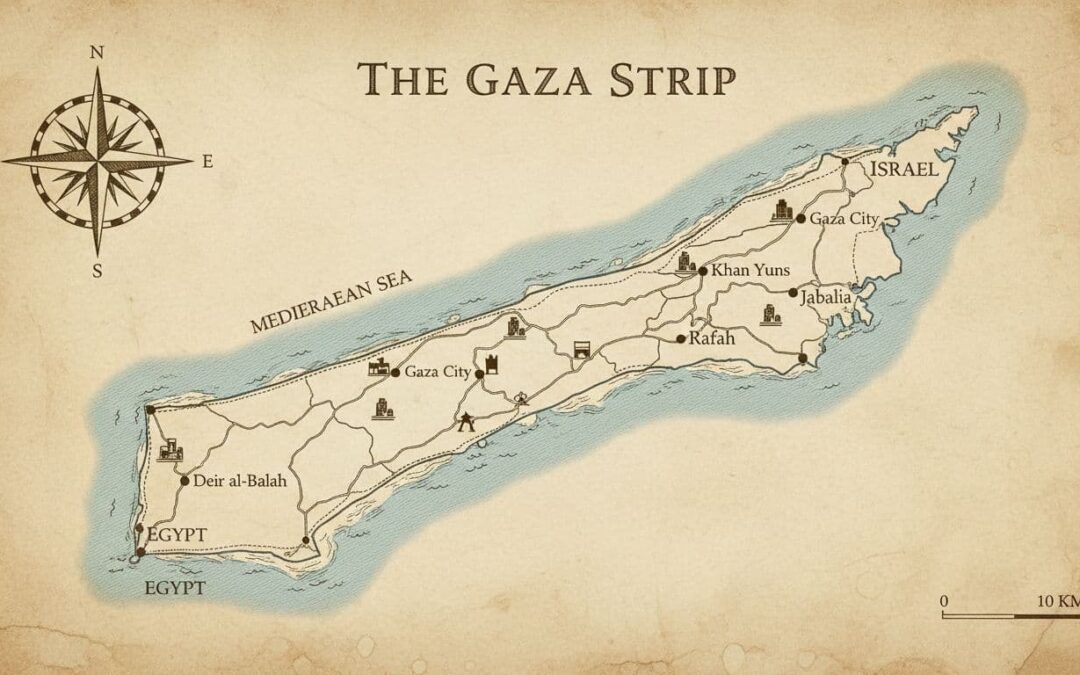
The Truth Behind The Numbers
Gaza Civilian Death Percentage Claims, Sources, Hamas, and Taqiyya Explained
People keep sharing a single number online, “what percent of the dead in Gaza are civilians,” but the real question is simpler and harder: who counted the deaths, how did they classify people, and can anyone check it?
As of Feb 2026, the most-cited public totals come from the Gaza Health Ministry (for example, 71,795 deaths reported as of Feb 1, 2026), with parallel tracking and partial verification efforts by UN bodies such as OHCHR, and competing claims from the Israeli government. What’s missing is a reliable, universally accepted civilian vs fighter breakdown, so any clean percentage you see should be treated as a claim, not a settled fact.
This article walks through where those numbers come from, what they actually measure, and what can and can’t be verified in a war zone (including gaps like bodies under rubble and limited access for independent checks). It also explains what Hamas is in Gaza, how it rose from a movement founded in 1987 to winning the 2006 Palestinian legislative elections, and how it seized full control of Gaza in 2007 after violent conflict with Fatah, then governed while also running an armed wing.
Finally, we’ll clear up a term that gets thrown around online: taqiyya (sometimes misspelled “yaqiyya”). In Islam, taqiyya is a narrow doctrine about concealing faith under threat to protect life and safety, it’s not a free pass for everyday lying; and claims that Hamas “uses taqiyya” as a standard strategy aren’t something these public sources prove on their own, so we’ll stick to what the records and primary documents actually show.
What numbers we actually have for Gaza deaths (as of February 2026), and who publishes them
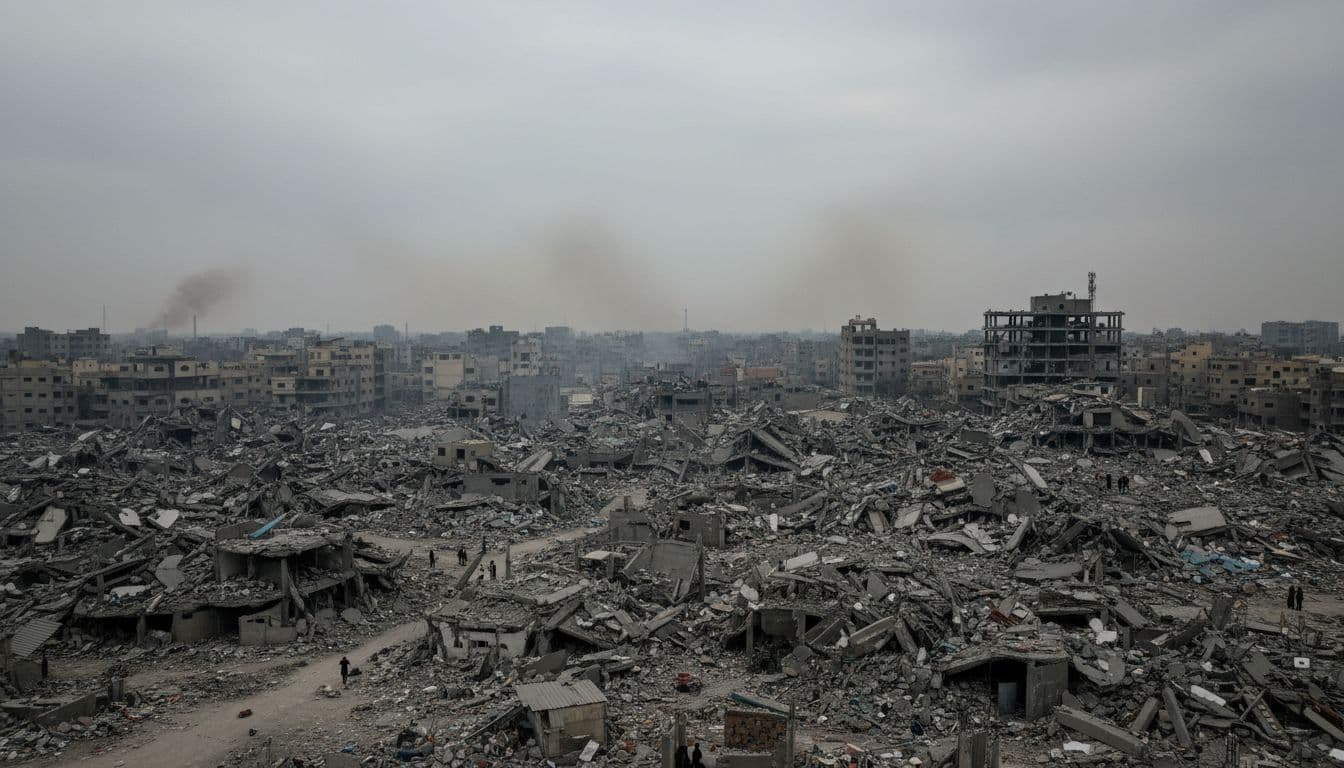 Rubble and destroyed buildings in Gaza after heavy fighting, created with AI.
If you want to understand the “civilian percentage” debate, you have to separate two things that people blend together online: total reported deaths and how many of those deaths were civilians.
As of February 1, 2026, the most cited public total is from Gaza’s Health Ministry: 71,795 deaths and 171,551 injuries. The same updates also warn that additional victims remain unrecovered under rubble or in areas rescuers cannot reach, which matters because a “death toll” can be a moving target long after the bombing pauses.
The labels are where things get messy. A civilian is someone not taking part in fighting. A combatant is someone who is part of an armed group or directly participating in hostilities. In Gaza, those lines can be disputed in practice because:
- Many fighters don’t wear uniforms.
- Some people have mixed roles (security, political wings, civil services).
- Records can be missing, bodies can be unidentified, and some deaths are reported long after the fact.
So when you see a clean percentage, ask the boring questions first: Which dataset is it based on, and how did they classify people? The answers are usually more complicated than a viral graphic.
Gaza Health Ministry numbers: what they count, and the biggest limits
In headlines, the Gaza Health Ministry is the default source. It operates under Hamas governance in Gaza, which is why many reports describe it as “Hamas-run.” That political reality doesn’t tell you the numbers are true or false by itself, but it does tell you who is collecting and releasing the data.
In plain terms, the ministry’s totals typically come from a blend of inputs, including:
- Hospital reports (patients who die in facilities, emergency intake logs).
- Morgue and burial records (bodies received, processed, or transferred).
- Family reports (relatives reporting deaths when hospitals are unreachable).
- Estimates when access is limited, especially during intense fighting or when entire areas can’t be reached.
That last point is important. When the system is breaking down, counting starts to look less like a spreadsheet and more like keeping score in a storm.
The biggest limits are not abstract, they’re practical:
- Chaos and displacement: people move constantly, families split up, and reporting chains break.
- Destroyed infrastructure: hospitals damaged, power and internet outages, paper records lost.
- Missing IDs: some bodies arrive without documents, some arrive in fragments, some never arrive.
- Double counting risk: the same person can be reported by a family and later appear in a hospital list (or vice versa) unless the system catches duplicates.
- No real-time civilian vs fighter split: the ministry’s public updates generally report totals and injuries, not a continuously updated breakdown of civilians versus combatants.
If you want to see how this gets presented in news coverage and why it’s contested, read BBC reporting on the Hamas-run ministry’s toll. Even careful reporting often circles back to the same bottom line: the ministry is the most continuous source, but the war makes perfect counting impossible.
UN and other groups: why they cite the same totals, and what “verified” means
A lot of people assume the UN has its own independent Gaza death database. In practice, many UN agencies and humanitarian briefings cite Gaza Health Ministry totals because they’re the most regular public dataset available during the conflict. That is less an endorsement and more a reality of access and time.
UN publications often use careful wording. Three terms get mixed up online, but they don’t mean the same thing:
- Reported deaths: Numbers provided by a source (often the Gaza Health Ministry) and repeated by others with attribution.
- Verified deaths: Cases that have been checked against documentation or corroborated (names, IDs, hospital records, multiple confirmations). Verification can be partial because access is limited and staff cannot always investigate on the ground.
- Estimated deaths: A statistical or analytical attempt to account for deaths not captured in reports (for example, people missing under rubble, deaths in unreachable areas, or indirect deaths from disease and lack of care).
Verification is also slow. Imagine trying to confirm identities while communications are down, hospitals are overwhelmed, and entire neighborhoods are inaccessible. That delay is a feature of the environment, not just a paperwork problem.
It also explains why you’ll see the same overall totals repeated across many outlets. UN OCHA, for example, commonly publishes updates that attribute casualty figures to the ministry, and it adds disclaimers about what is and isn’t verified. You can see that attribution style in an OCHA reported impact snapshot.
So if someone says, “The UN verified the death toll,” press for details. Which part was verified, how many cases, and on what timeline? “Verified” is not a magic stamp that instantly turns a wartime count into a full civilian percentage.
What Israel and the IDF say, and why that still does not give a clear civilian percentage
Israel’s statements and the IDF’s statements matter for two separate questions: the total number killed and how many of those killed were fighters. People often treat those as the same debate, but they are different claims that can move independently.
As of early 2026, an IDF senior official has accepted a total of about 70,000 killed as largely consistent with the Gaza Health Ministry’s overall figure (the ministry reported 71,795 deaths as of Feb 1, 2026). This shift is widely reported, including by BBC coverage of an Israeli official accepting the 70,000 figure.
At the same time, Israel often focuses on fighter (combatant) estimates, for example how many Hamas militants were killed. Here’s the catch: those estimates are usually presented as separate from the ministry’s total death count, and they’re not always published with enough underlying detail for outsiders to audit case by case.
Even when two sides converge on a similar total number, you still do not get an agreed civilian percentage, because you’d still need answers to questions like:
- How many of the dead were combatants, and what definition is being used?
- How were edge cases classified (police, civil defense, armed members off duty, teenagers involved in fighting)?
- How many deaths are still missing under rubble and uncounted, and how will those be categorized later?
A simple analogy helps: agreeing on the total is like agreeing how many marbles are in a jar. Arguing over civilian percentage is arguing how many are blue versus red when the lights are off and the labels are smudged. Until there’s a shared, auditable classification method, any clean civilian percentage is more a claim than a conclusion.
So what percentage of the dead are civilians, and can that claim be verified
People want a clean answer, like, “It’s 70% civilians” or “It’s 40%.” The problem is that, as of Feb 2026, the most widely cited public death totals (like the Gaza Health Ministry’s running total) don’t come with a consistent, regularly updated public breakdown of civilian vs combatant. That means there’s no single civilian percentage that everyone can point to and audit the same way.
So why do percentages keep going viral? Usually because someone is using an older snapshot, mixing datasets, using a different definition of “combatant,” or doing simple math based on assumptions (like treating “women and children” as “civilians,” which isn’t always the same thing). You can still evaluate a claim, but you have to check what it’s actually counting.
Why “civilian” is not a simple label in this war
In movies, it’s easy, soldiers wear uniforms, civilians don’t. In Gaza, that’s not how it looks on the ground. A “civilian percentage” sounds like a fact, but it often hides hard classification problems.
Here are common reasons the label gets messy:
- Fighters without uniforms: Many armed-group members blend into civilian clothing. After a strike, an outside observer may not be able to tell if a dead man was a fighter, a civilian, or both at different times.
- Police vs military roles: Some security forces do normal policing (traffic, crowd control), but in some systems they also have wartime roles or ties to armed groups. One side may label them “combatants,” another may label them “civil servants.”
- People forced into tasks: In war, civilians can be pressured into driving, carrying supplies, digging, relaying messages, or guarding a site. Are they civilians, human shields, coerced helpers, or “direct participants”? The answer can change depending on the rulebook someone uses.
- Teenagers: Many datasets use age cutoffs (like under 18) as a proxy for civilian status. But in real conflicts, some teens are recruited, armed, or used in support roles. Treating every teen as a civilian can be wrong, and treating every older teen as a fighter can also be wrong.
Also, different groups define “combatant” differently. Some use a narrow legal definition (formal members of an armed group, or people directly taking part in fighting). Others use a broader definition (anyone affiliated with a governing security structure). That choice alone can swing the “civilian percentage” a lot.
When you see a civilian percentage online, use this quick reality-check before you share it:
- What date range is it from? A percentage from early 2024 is not “the current ratio” in 2026.
- Which dataset is it based on? Gaza Health Ministry totals, UN verified lists, NGO databases, or an estimate?
- Is it total deaths, or only identified deaths? A ratio based on identified bodies can shift when more names are confirmed.
- How are fighters defined? Uniformed only, armed members, police, political wing, “military-age males,” or something else?
- Is there a link to the original report or method? If you can’t trace it, treat it like a rumor with a spreadsheet font.
If you want a feel for how disputed “fighter counts” can be even when totals are similar, see BBC Verify’s look at militant death claims.
What can be checked by outsiders, and what cannot (yet)
Verification during a war is like trying to do bookkeeping during a house fire. You can still learn real things, but you can’t pretend you have a clean final audit.
Here’s what outsiders can sometimes check, at least in part:
- Name lists and identifiers: When authorities release lists of the dead (names, ages, ID numbers), researchers can look for duplicates, missing fields, or patterns. Independent groups can cross-check a portion through family contacts or local records.
- ID checks and civil registry matching: If an ID number matches a real person in a registry, that supports “this person existed,” but it still doesn’t prove how they died or whether they were a combatant.
- Hospital logs and morgue records: These can support that bodies arrived, were recorded, and were processed. But hospitals can also be overwhelmed, communications can fail, and records can be incomplete.
- Strike verification (location and timing): Satellite imagery, video, and open-source investigations can often confirm that a building was hit and when. What it usually cannot confirm is who was inside or what their status was. A crater proves impact, not identity.
- Later forensic review: After fighting slows, investigators can do deeper work, including interviews, document review, and in some cases forensic identification. That takes time, access, and resources.
Now, here’s what cannot be fully verified during active conflict, at least not at scale:
- Complete identity matching for every death: Many deaths are reported without complete paperwork. Some bodies are fragmented, decomposed, or never recovered. Displaced families may not be reachable to confirm details.
- Cause of death for each person: Even if someone is on a list, proving the exact cause (strike, collapse, gunfire, illness due to lack of care) can require medical records and scene access that simply aren’t available for every case.
- Accurate fighter status for every person: This is the biggest gap. Membership records of armed groups aren’t public, uniforms aren’t reliable, and affiliation can be hidden. So “civilian percentage” claims often rest on assumptions, not confirmed status.
The rubble issue matters more than most people realize. Large numbers of victims can remain unrecovered under debris for weeks or months, and some are only added later when bodies are retrieved or people are declared dead. That delays certainty and can shift the makeup of the list (identified vs unidentified, adult vs child, male vs female) long after the headlines move on. UN situation reports regularly flag these access and recovery limits, including the ongoing constraints on rescue and documentation (see OCHA reporting via ReliefWeb).
Bottom line: you can sometimes verify parts of a death toll, and you can often verify that destruction happened. But a precise, universally accepted “civilian percentage” is much harder to prove in real time, because the numerator (confirmed civilians) and the denominator (total dead, including those under rubble and unidentified) keep moving, and the definitions are contested.
Hamas in Gaza: how they rose, how they won an election, and how they kept power
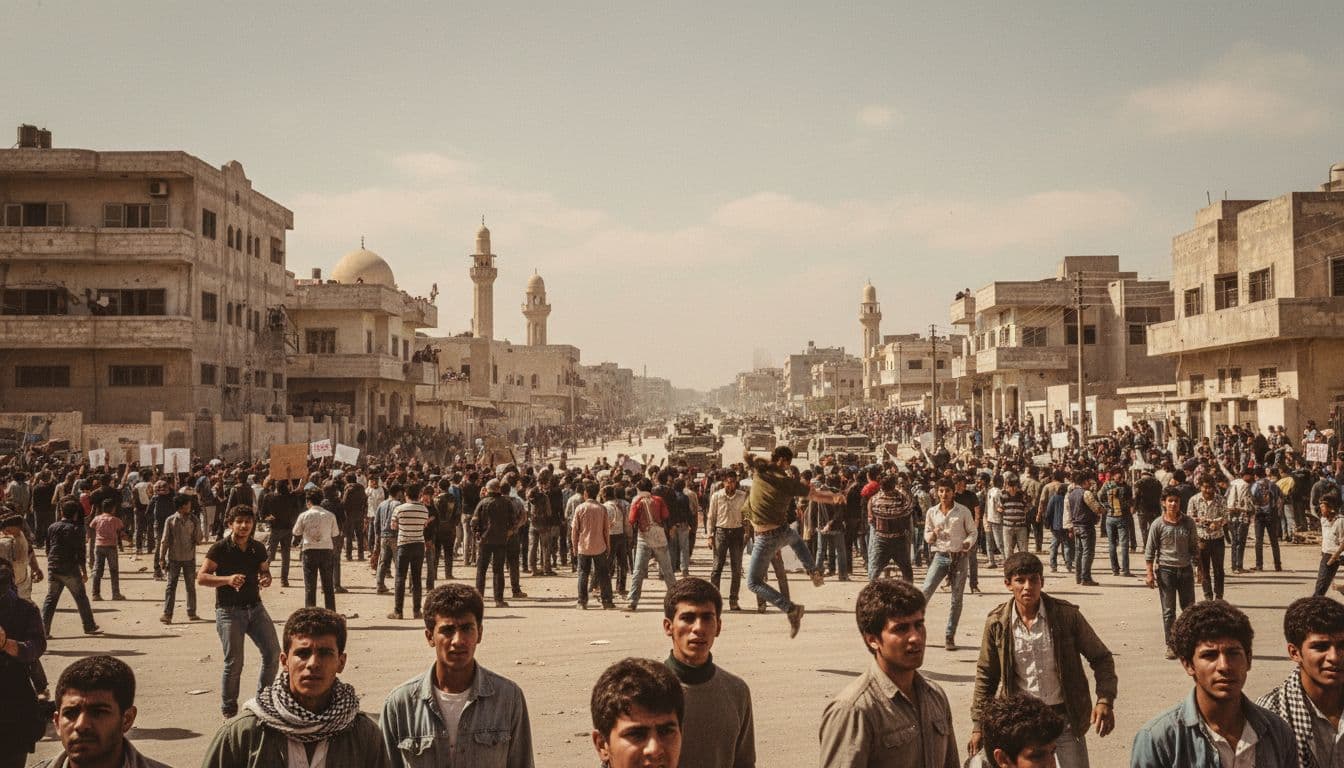 Street protest scenes in Gaza during the First Intifada, created with AI.
If you’re trying to judge claims that come out of Gaza (including casualty reporting), it helps to understand what Hamas is and what “Hamas-run” actually means in practice.
Hamas is both a political movement and an armed organization. When it governs, it helps run day-to-day administration in Gaza, including ministries and public services. At the same time, it also has an armed wing and a stated doctrine of armed resistance. Those two tracks overlap, and that overlap is part of why Gaza’s institutions are so contested in public debate.
Here’s the basic timeline that matters for the rest of this article: origins linked to the Muslim Brotherhood, founding during the First Intifada in December 1987 under Sheikh Ahmed Yassin, a founding charter in 1988, an election win in January 2006, then a June 2007 armed takeover that left Hamas ruling Gaza from that point on.
From the Muslim Brotherhood to Hamas: what they started as and what they say they stand for
Hamas (an Arabic acronym commonly translated as Harakat al-Muqawama al-Islamiyya) is often rendered in English as the Islamic Resistance Movement. The name matters because it signals the movement’s self-image: not just a party, but a resistance project framed in religious terms.
Its roots are tied to Palestinian Islamists associated with the Muslim Brotherhood, and it emerged as a distinct organization during the First Intifada (late 1987). Over time it developed both a social base (charitable and community networks) and a militant structure. A useful high-level background source that summarizes those origins and the “movement plus armed group” reality is the Middle East Institute Hamas profile.
Hamas’s 1988 founding text, commonly called the charter or covenant, is blunt about goals. In plain language, it presents the conflict as a religiously framed struggle over Palestine, rejects Israel’s legitimacy, and promotes jihad and armed struggle as the route to “liberation.” The full text is widely archived, including in the 1988 Hamas covenant document.
In 2017, Hamas issued a new political document that many readers interpret as a softening in tone on some points, for example discussing a Palestinian state along 1967 lines as a formula. But it still did not recognize Israel, and it still endorsed “resistance” as central. Reporting on that document often highlights this mix of moderated language and unchanged bottom lines (see coverage of the 2017 Hamas document).
Did Hamas get voted in, and what happened after the 2006 election
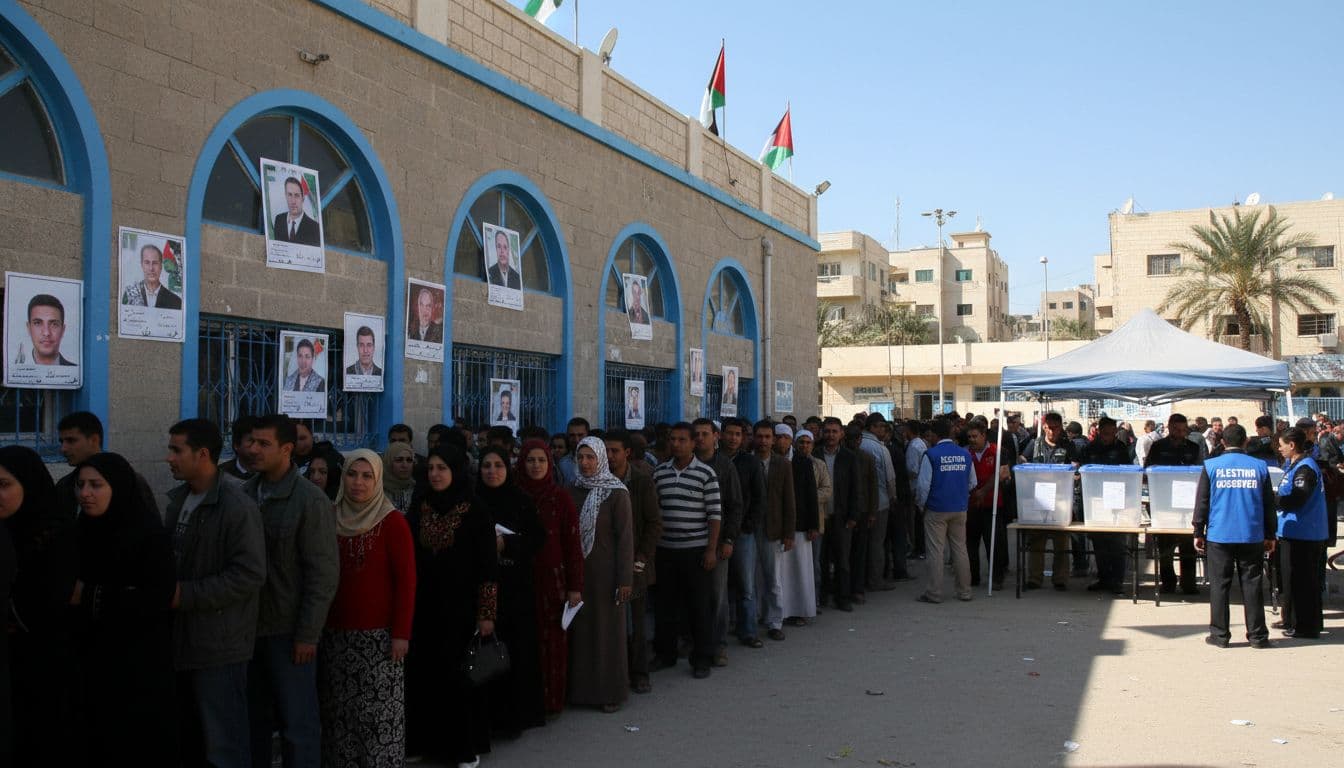 Voters lining up at a Gaza polling station in 2006, created with AI.
Yes, Hamas won an election. In January 2006, Hamas won the Palestinian Legislative Council elections and formed a government.
That fact often gets used like a stamp of permanent legitimacy, but here’s the key point to keep straight: winning an election once is not the same thing as holding regular elections afterward. The 2006 result explains how Hamas entered government; it does not, by itself, describe how Gaza has been governed year after year since.
After the 2006 election, tensions between Hamas and Fatah escalated into armed conflict. In June 2007, Hamas took full control of the Gaza Strip by force, pushing out Fatah in what is often described as the Battle of Gaza. A contemporaneous account of the takeover is documented in reporting on Hamas taking control of Gaza.
From that point on, Hamas ruled Gaza, while the Palestinian Authority (dominated by Fatah) remained centered in the West Bank. In practical terms, “ruling Gaza” meant Hamas-controlled authorities overseeing internal security and parts of civil administration, while also remaining an armed movement with its own military capacity.
That split matters for the rest of this post because it explains why many institutions in Gaza are described as “Hamas-run,” even when they look, on the surface, like ordinary ministries.
Taqiyya: what it means in Islam, and what it does and does not prove about Hamas
 A symbolic scene of concealing belief under threat, created with AI.
If you spend five minutes in comment sections about Gaza, you’ll see taqiyya thrown around like a trump card. People often use it to mean, “You can’t believe anything a Muslim says.” That’s a serious claim, and it’s also a misunderstanding.
In Islam, taqiyya is best understood as concealing faith under threat. It’s tied to safety, coercion, and survival, not normal life, not politics, and not an all-purpose permission slip for dishonesty. It also shows up differently across Islamic traditions (it’s historically more emphasized in Shiite contexts, but Sunni legal discussions include limited versions too).
The key takeaway for this article: taqiyya is a religious-legal concept, while propaganda, messaging discipline, and strategic deception are broader wartime behaviors found in many conflicts. Mixing those categories leads to sloppy analysis.
Plain-English definition of taqiyya, and the common misunderstanding online
Taqiyya (often misspelled online as “taqiyah,” “taqiyyah,” or other variants) means, in plain English, hiding your religious belief when telling the truth would get you hurt or killed. Think of it like a legal “self-defense” exception in extreme circumstances, not a lifestyle.
A simple example helps. Imagine someone is asked, “Are you Muslim?” at a checkpoint, and answering “yes” could mean torture or death. Taqiyya is the idea that protecting life can allow concealment in that kind of scenario. It’s not about tricking people for profit, winning an argument online, or advancing a political project.
Why does the misunderstanding spread so easily? Because it gets packaged as a blanket rule: “Muslims can always lie to non-Muslims.” That’s not what taqiyya is, and it’s not how most Muslims live. Context is the whole point.
If you want a careful definition that also flags how journalists should use the term, see the Centre for Media Monitoring’s taqiyya entry. For a general overview, Britannica’s taqiyyah summary covers the basic idea and history.
How to talk about Hamas messaging without turning taqiyya into a catch-all
If you’re trying to evaluate Hamas statements, you don’t need a theological shortcut. You need documents, timelines, and consistency checks.
Start with what Hamas has actually published and said publicly. A practical method looks like this:
- Compare key texts over time. Look at the themes and claims in the 1988 charter and then compare them to the 2017 “General Principles and Policies” document. Even when language changes, ask what stays the same. One commonly cited archive that presents both texts is Revised 2017 and original 1988 charters. (You don’t have to agree with a source’s framing to use it for text comparison.)
- Check official statements (spokespeople, political bureau, official channels). Don’t judge a movement by a random clip that lacks context or a screenshot with no date.
- Track consistency across moments. When claims shift, ask why. Was it aimed at foreign media, local supporters, negotiators, or rivals? That’s political strategy, not automatically religious doctrine.
- Separate “Islamic doctrine” from “wartime messaging.” Religious concepts can shape identity, but they do not explain every PR move any more than “just war” explains every statement by a Christian-led government.
Now, about the taqiyya accusation itself. If someone says, “Hamas uses taqiyya,” don’t accept it as self-evident. Ask for evidence that actually connects the dots:
- An explicit Hamas reference to taqiyya as a strategy (in speeches, training, internal guidance, or official writing).
- Credible scholarship or reporting that documents Hamas adopting the doctrine, not just people asserting it.
- A clear chain from the religious concept to specific messaging decisions, with dates and sources.
As of early 2026, public-facing Hamas materials do not appear to explicitly cite taqiyya as a named doctrine guiding strategy (so the claim often functions as suspicion, not proof). If your goal is to understand Gaza casualty narratives and Hamas credibility claims, the fair move is boring but strong: stick to primary texts, verify quotes, and treat big accusations like big accusations.
Article in Review
The civilian percentage question sounds simple, but it sits on top of moving parts: incomplete recovery, shifting lists, and disagreements over what “combatant” means when fighters don’t wear uniforms and roles overlap. As of Feb 2026, the most-cited public total is 71,795 deaths from Gaza’s Health Ministry (with repeated notes about bodies still under rubble and areas crews can’t reach), and even a senior Israeli military official has broadly accepted the overall scale (around 70,000), but that still doesn’t produce a clean, shared civilian percentage you can audit.
On the politics side, Hamas matters because it is not just a militia or just a party. It began in 1987 out of Islamist networks tied to the Muslim Brotherhood, won the 2006 Palestinian legislative elections, then took full control of Gaza in 2007 after violent conflict with Fatah, and has governed Gaza while also running an armed wing. And on the religious term that keeps getting thrown around, taqiyya has a narrow meaning in Islam (concealing belief under threat to protect life), it is not a blanket license to lie; “yaqiyya” is usually just a misspelling people use online, not a separate doctrine you can cite as evidence.
Takeaways
- As of Feb 2026, the reported total deaths are widely cited (Gaza Health Ministry: 71,795), but a single verified civilian percentage is not available from the latest public updates.
- Sources differ because their methods and definitions differ, and “civilian” vs “combatant” is often disputed in real time.
- Verification is hard during war, especially with bodies under rubble and limited access to records.
- Hamas history includes both an electoral victory in 2006 and a violent takeover in 2007, then long-running rule in Gaza.
- Taqiyya has a specific meaning, and it shouldn’t be used as a blanket claim about Muslims or Hamas statements.
When you see a percentage, slow down and check the original dataset, the date, and the definitions before you share it.