Time Travel Through Slavery: From Muslim Markets to Rome and Modern Money
Picture standing in present day America, thinking about plantations, chains, and the Atlantic slave trade. Now imagine hitting a mental rewind button and watching time run backward.

Ships go back across the ocean. People once enslaved in the Americas reappear in crowded coastal markets. The rewind keeps going, all the way to ancient Rome. At each stop, slavery looks a little different, but power, law, and money keep repeating like a broken record.
This article walks through three big stages: Muslim controlled markets where Africans were first bought, why people were enslaved in those systems, and what slavery looked like in ancient Rome. Then we jump to today and look at how Islamic ideas about interest and loans shape housing and wealth in some communities.
The goal is not to attack any group. It is to see how systems, beliefs, and laws shaped real human lives, so we can talk honestly about dignity and justice now.
From Present Day America Back to the First Slave Markets
Most people in the United States learn about slavery through the Atlantic trade. European ships, West African coasts, and plantations in the Americas fill the picture.
What many never hear is that a lot of those captives passed through markets where Muslim and Arab traders were already buying and selling people. The Arab Muslim slave trade in Africa started in the 600s and lasted for over a thousand years, long before Columbus and long after the Atlantic trade began.
How Enslaved Africans Reached the Americas Through Muslim-Controlled Markets
In North and East Africa, busy markets stood near ports and caravan routes. African raiders, local rulers, and Arab merchants brought captives from the interior. Some were prisoners of war, some were kidnap victims, some had been condemned under local laws or debt systems.
Most people in this trade were moved to North Africa, the Middle East, and parts of Asia. Historians who study the history of slavery in the Muslim world point out that millions of Africans were taken over many centuries.
European traders sometimes bought captives in those markets, especially on the West and Central African coasts. They saw human beings as “cargo,” loaded them onto ships, and forced them across the Atlantic. By the time those ships reached what is now the United States, people had already passed through several layers of capture, sale, and transport.
Key Slave Routes: Sahara, Red Sea, and Indian Ocean
The trade did not happen on a single road. It spread across a web of routes:
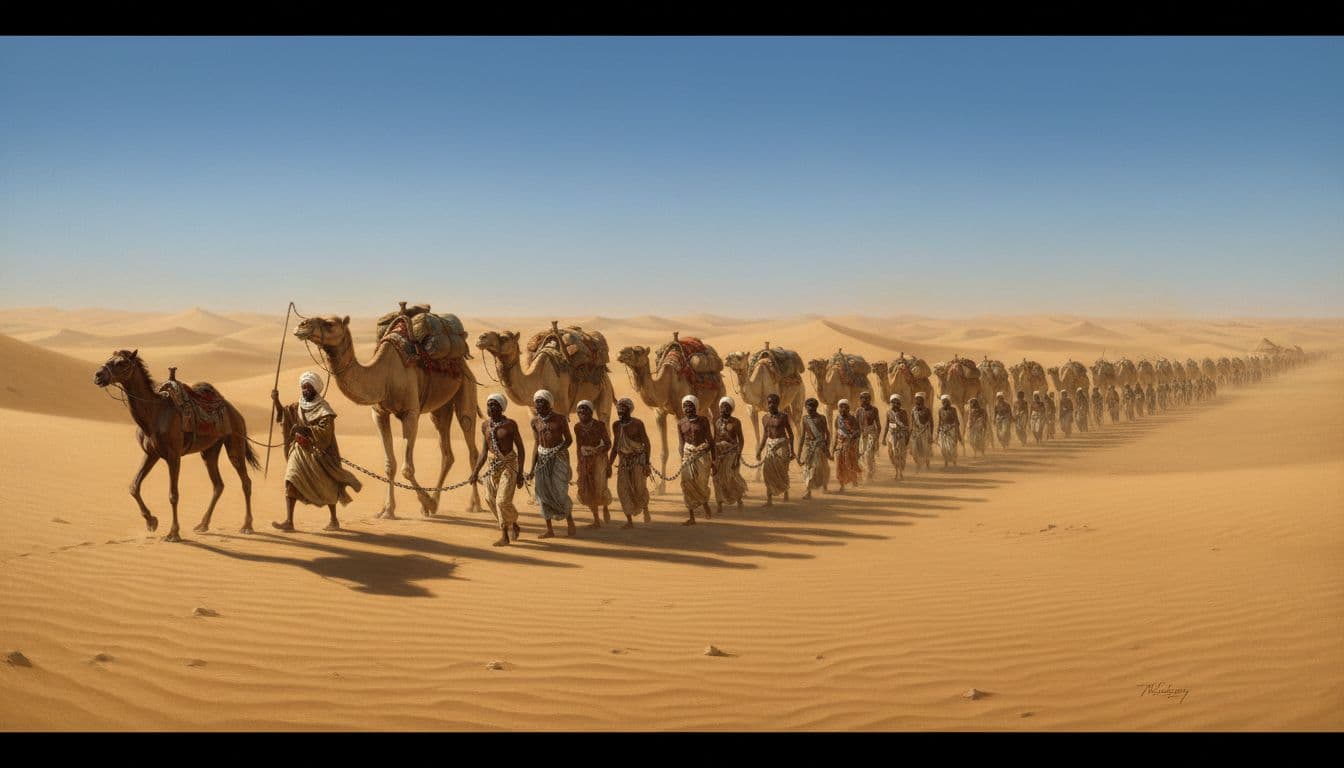
Caravan of enslaved people crossing the Sahara in the trans-Saharan trade.
- Across the Sahara, caravans dragged chained captives from West and Central Africa to cities in North Africa. The trans-Saharan slave trade fed markets from Morocco to Egypt.
- From East Africa, traders shipped people across the Red Sea and Indian Ocean to Arabia, Persia, and beyond. Places like Zanzibar became centers of export, as described in reports on East Africa’s forgotten slave trade.
Many died from thirst, hunger, and abuse before they ever reached a market or a ship. The Atlantic trade was one part of a much larger system of slavery that covered continents.
Why People Were Sold Into Slavery in Muslim Markets
So why did a specific person end up for sale? The answers were messy. War, crime, debt, greed, and politics all played a part. Both Islamic Sharia Law and local African laws were used, and sometimes twisted, to justify what was happening.
A good overview of slavery in Africa shows how older African practices blended with newer Islamic and global markets.
Conquest and War: Enslaving the Conquered
One major path into slavery was losing a war. When Arab, Berber, or allied African armies won a battle, they often took prisoners. Many Muslim jurists at the time taught that non Muslim prisoners of war could be enslaved, ransomed, or in some cases released.
Raids on border villages were common. Armed groups attacked at night, burned homes, and drove survivors away in chains. Even during “peace,” these raids kept the supply of captives flowing.
Crime, Punishment, and Slavery Under Sharia Law and Local Laws
Some people were enslaved as punishment. In certain regions, repeated theft, violent robbery, armed rebellion, or unpaid large debts could lead to loss of freedom.
Sharia Law, in its classical sense, is the broad body of Islamic law and ethics drawn from the Quran, the sayings of the Prophet Muhammad (hadith), and centuries of juristic interpretation, and it covers everything from personal worship and diet to family life, contracts, and crime, as outlined in resources like Britannica’s overview of Sharia Law. In practice, Sharia Law isn’t one single code that every Muslim agrees on, it’s interpreted through different schools of thought, so what it looks like in daily life can vary a lot from one country or community to another.
In many places with Muslim majorities, Sharia Law works as one layer of law among others, for example, some countries use it only for personal status issues like marriage, divorce, and inheritance, while others base much or all of their criminal law on it, a point explained in more detail by the Council on Foreign Relations’ backgrounder on Sharia Law and the law.
Where governments apply Sharia Law as state law, consequences for breaking it depend on the area of law and on local interpretation; they can range from financial penalties and prison, to corporal punishments, to strict rules around family disputes and public morality. Countries such as Saudi Arabia, Iran, and Afghanistan have legal systems where Sharia Law plays a central role in criminal and civil law, while others, like Egypt, Pakistan, and Malaysia, use Sharia Law mainly in family law or as a constitutional reference that guides legislation.
Some northern states in Nigeria, along with parts of Somalia and Sudan, apply Sharia-based criminal codes for Muslims, which can involve penalties that human rights groups strongly contest, including flogging or amputation, though these punishments are not always carried out in practice.
In contrast, the United States doesn’t have Sharia Law as a source of government law, and the Constitution bars any religious code from replacing federal or state law, even though Muslims, like other religious groups, can order parts of their private life by their own beliefs. What you sometimes see in the U.S. is limited use of religious rules in private settings, such as Islamic marriage contracts or arbitration panels in family or business disputes, but any decision from those settings only stands if it fits American law and basic rights.
Some state legislatures have talked about or passed “anti-Sharia” or “anti-foreign-law” bills, yet these are mostly political signals, since courts already have to reject any religious rule that clashes with constitutional protections. So at this point, Sharia Law isn’t close to being enacted as public law anywhere in the United States; the legal system is secular, and while religious communities can guide their members’ behavior, they can’t turn their internal rules into binding state or federal law.
In the past, Sharia Law, as interpreted by some rulers, allowed slavery within a framework of rules, such as bans on enslaving free Muslims and calls to treat slaves with a degree of care. Local African customs sometimes allowed enslavement of criminals or enemies as well.
In practice, power often mattered more than rules. Leaders and traders sometimes labeled rivals as “rebels” or “criminals” mainly so they could sell them. The legal language came afterward, as a cover for profit.
For a deeper academic angle, you can see how scholars describe the Islamic world in the history of slavery.
Debt and Desperation: When Poverty Led to Slavery
Imagine a farmer hit by drought. His crops fail. He borrows grain to feed his family. The next harvest fails again, and he cannot repay.
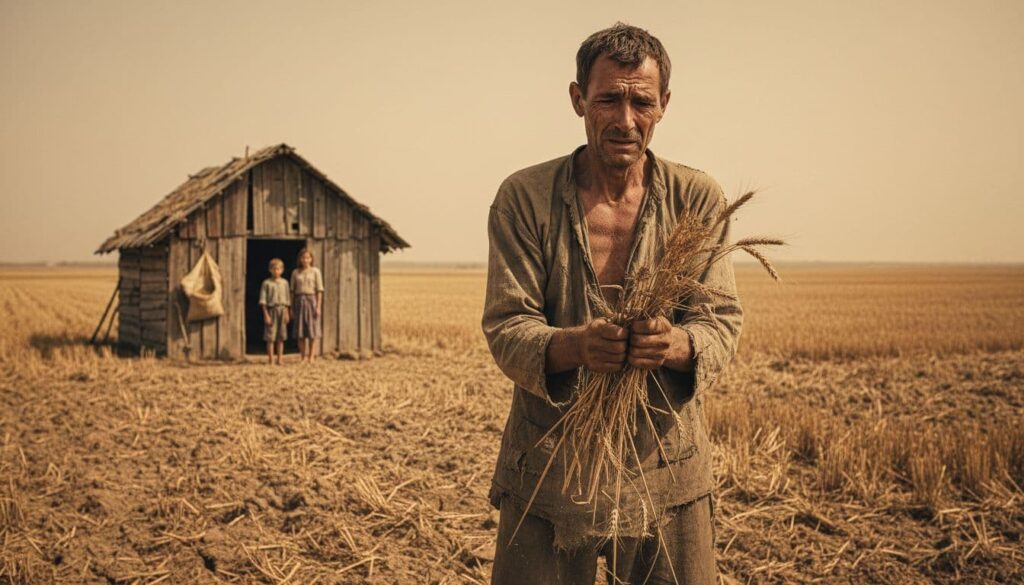
In some places, that kind of debt could lead to being sold, either for a set term or for life. Parents sometimes gave up children in the hope they would at least eat. Poor families were pulled into slavery by hunger rather than open war.
Debt bondage created a direct link between economic systems and the spread of human sale.
Raids, Kidnapping, and the Business of Human Lives
Not every captive could be explained by law or war. Many were simply stolen.
Armed bands attacked markets and river crossings, grabbed people on roads, and sold them. Some African leaders joined this trade, working first with Muslim merchants, then later with Europeans. Profit, not law, drove these choices.
Writers who describe the Arab-Muslim slave trade report scenes of villages burned simply to capture people. Any talk about Sharia Law or local custom often came later, as a way to make the business look respectable.
Looking Back Further: Slavery as a Way of Life in Ancient Rome
Now hit rewind again, past the first Muslim markets, past early Christianity, all the way to the Roman Empire.
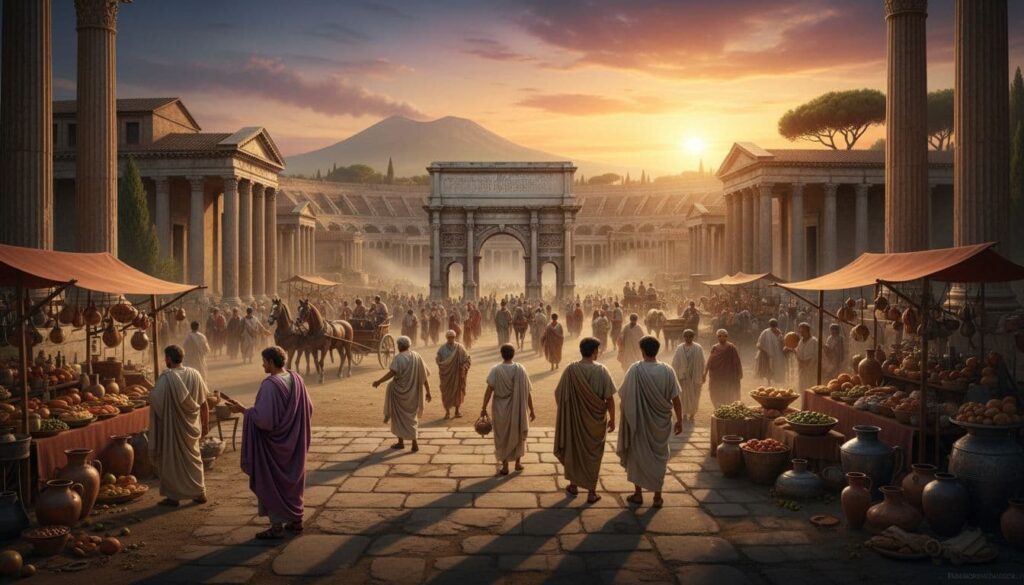
In Rome, slavery was built into daily life. It powered farms, mines, households, and even city governments. Most enslaved people were war captives or the children of enslaved parents, not one single ethnic group. If you want a broad snapshot, the article on slavery in ancient Rome lays out the basic structure.
When people compare the United States to the Roman Empire, they’re usually talking about more than memes and marble statues; they’re asking where we sit on that timeline from confident rise to messy decline. Many historians argue that America now looks less like early, expanding Rome and more like the late republic, with sharp partisan conflict, powerful elites, and a public that’s deeply worn out by constant crisis, a pattern Niall Ferguson lays out in his interview on America’s “late republic” moment in Noema.
Rome, at that stage, still looked strong on the outside, with big armies and impressive wealth, but its politics had turned into a brutal contest for power, rules were bent for short-term wins, and ordinary people felt that the system no longer served them.
The United States shows some of this: long, grinding polarization, mounting public debt, culture wars that feel like permanent background noise, and a sense that institutions are overloaded and slow to respond. At the same time, the U.S. is far more democratic than Rome ever was, with regular elections, a written Constitution, and a culture of rights that even loud internal fights haven’t fully erased, which makes a sudden “fall of 476 A.D.” style collapse far less likely, as writers like Johan Norberg argue when they weigh American power against Rome in the Washington Post.
Rome slid into crisis as its middle class shrank, its frontier defenses stretched thin, and its political class treated the state as a prize rather than a trust; the U.S. faces similar warning lights in rising inequality, fatigue over foreign wars, and growing doubt that elections will settle disputes peacefully. If we line up the timelines, America looks like a rich, still-mighty republic that has not yet broken apart, but is clearly testing the outer edges of its own system, the way Rome did in the century before Caesar.
The future, if we follow that Roman template without correction, likely holds more institutional strain, louder constitutional arguments, sharper class divides, and a slow drift toward either gridlock or rule by a smaller, more aggressive group that promises “order” at the price of civic freedom. But history is comparison, not destiny; Rome had no advanced science, no mass literacy, no instant communication, and no broad memory of other collapsed empires to warn it, while Americans can study those patterns in real time, listen to voices across the spectrum, and choose reforms that Rome never imagined.
So if we’re honest about the parallels, we’d say the United States is in a late-republic phase, not yet in free fall, standing at a fork in the road where repeatable Roman mistakes are flashing like bright red signs, and whether the story bends toward renewal or real decline depends less on abstract “fate” and more on whether citizens, leaders, and institutions are willing to change course while there’s still time.


How Conquest Fed Roman Slavery
Rome grew through conquest. When its armies took a city, survivors could be killed, ransomed, or sold. Thousands of people at a time were marched into markets.
Romans saw this as normal. Losing a war meant losing not just land but freedom and family. Gauls, Greeks, Jews, Africans, and many others all ended up in chains.
Types of Roman Slaves: From Fields and Mines to Homes and Offices
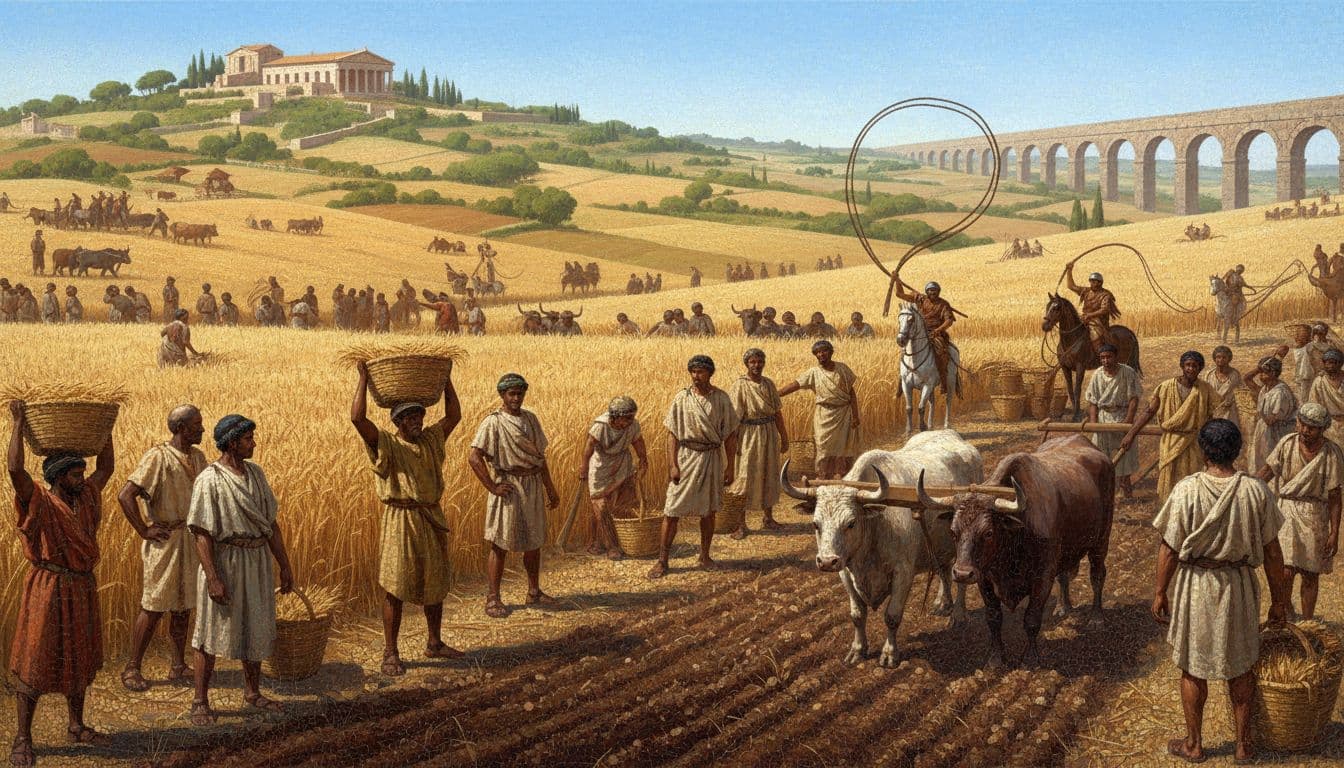
Ancient Roman estate farm with enslaved workers in wheat fields.
Roman enslaved people worked in many settings:
- On huge estates in the countryside, they plowed, harvested, and tended animals. Life there was harsh and short.
- In mines, they labored in deadly tunnels.
- On ships, they rowed for long hours.
- In cities, they cooked, cleaned, raised children, and did skilled work like teaching or accounting.
For a minority in skilled roles, daily life could feel almost middle class. But the core reality remained slavery. They were owned, not free.
Money, Wages, and the Limits of Freedom in Roman Slavery
Some Roman enslaved people could hold a kind of “pocket money,” called peculium. They might earn it through extra work or tips. In some cases, they could save enough to buy freedom or cut a deal for manumission.
Research on the Roman slave peculium shows how this worked as a social and legal tool. A few highly trained slaves, like doctors or managers, could live better than free poor citizens.
Yet even the best paid remained property until freed. Buying land or a house was usually out of reach until after manumission, and many never got that chance.
Islamic Rules About Interest, Loans, and Housing Today
Jump back to the present. In many Muslim communities, questions about money touch deep religious beliefs.
Islamic teaching strongly criticizes riba (interest). Many scholars teach that Muslims should not charge or pay interest to each other, especially on loans that feel exploitative.
What Sharia Law Says About Interest and Lending
In simple terms, Sharia Law views fixed interest as unjust, because it lets lenders profit with no shared risk. So some Muslims offer interest free loans inside their families or communities. Others use Islamic finance tools that share profit and loss instead of charging a set rate.
Modern Islamic mortgage models often use structures like murabaha (cost plus sale) or diminishing musharakah (gradual shared ownership). Articles that unpack riba in housing and halal home finance show how these products try to match both faith and modern housing markets.
When Muslims Charge Interest to Others and How It Can Shape Housing
Some people claim that Muslims will give fellow believers interest free deals while charging non Muslims normal or even higher interest. Reality is more mixed.
In many places, Islamic banks offer their products to anyone, Muslim or not. In others, informal community lending may favor insiders. Where Muslims have access to cheaper or interest free finance, they can sometimes buy homes more easily. Those outside those networks may face higher costs.
This can shape local housing patterns. Lower cost money can help one group buy and hold property, while others stay renters. At the same time, many Islamic finance thinkers try to build models that are ethical to all, not just Muslims, as seen in debates on problems with Islamic mortgages.
What These Histories of Slavery Teach Us Today
So what ties all of this together, from Roman markets to Muslim caravans to modern banks?
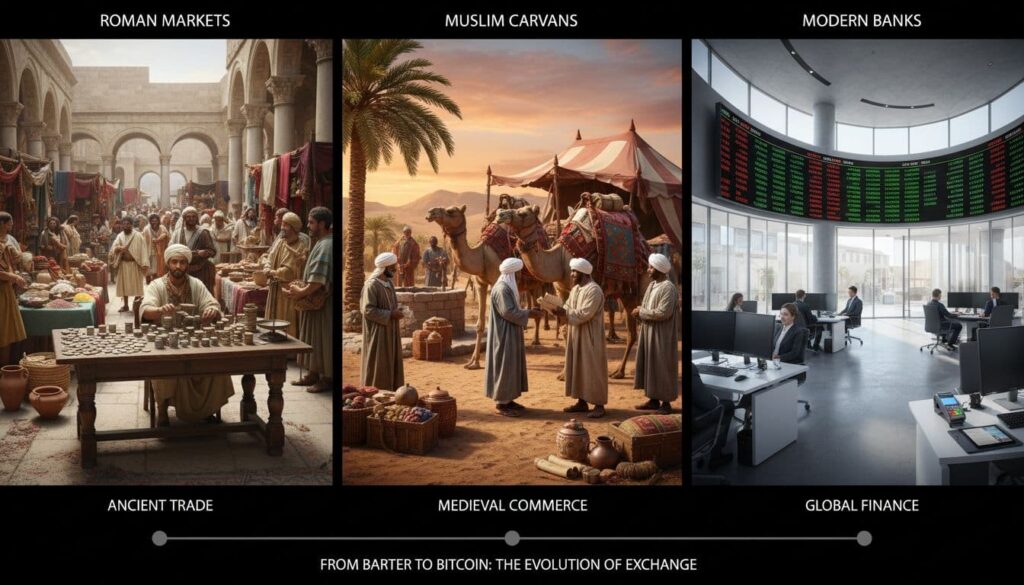
Patterns repeat. Conquest feeds slavery. Laws and religion are used, and sometimes abused, to justify control. Debt and poverty put the weakest at risk. Profit often speaks louder than compassion.
For Christians who want a broader historical frame for questions of power and faith, this church history overview shows how the early Church itself grew inside empires that used slavery.

Seeing the long story helps us spot problems today. When debt traps families, when housing systems quietly favor some and burden others, we are seeing softer versions of the same old forces: power, law, and money shaping human lives.
Conclusion
We started in present day America, then rewound to the first markets that fed the Atlantic trade, then further back to Roman roads and estates. At each stop, slavery grew out of war, law, debt, and the hunger for profit.
We also saw how Islamic ideas about interest and loans still affect who gets to own a home and build wealth. Systems can either guard dignity or grind it down.
The challenge now is simple to say and hard to live: build laws, economies, and communities that protect people instead of pricing them as units of labor or debt. That takes empathy, careful study of history, and a stubborn commitment to justice so that the worst patterns of the past are not replayed in new forms.