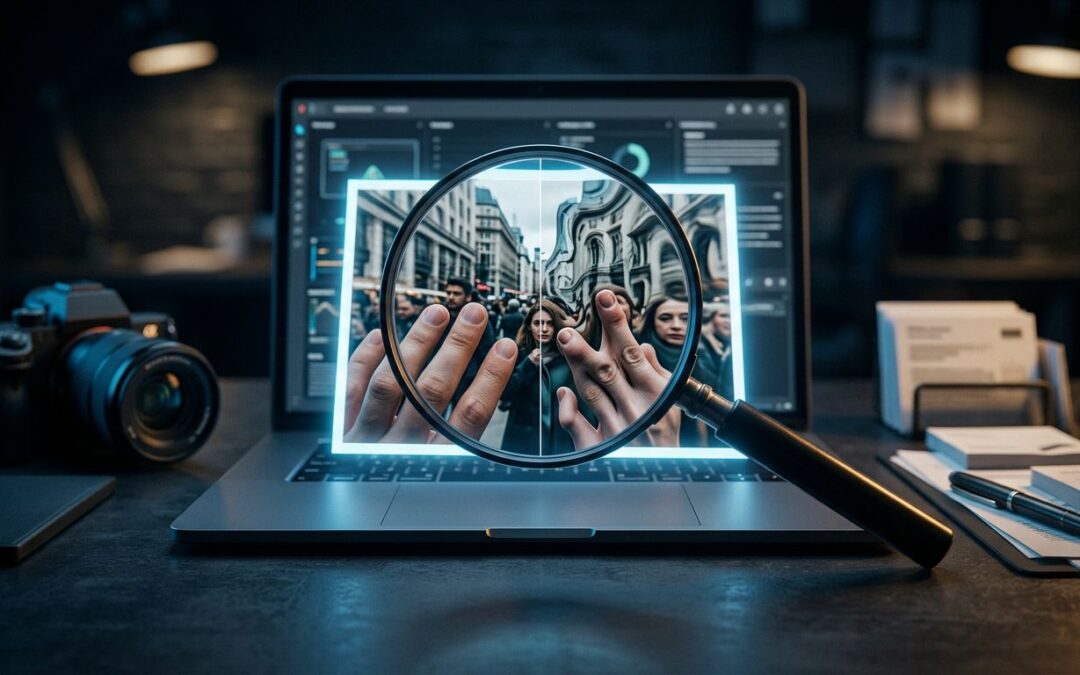
A polished image can move faster than the truth behind it. One dramatic scene, shared without a source, can shape public opinion and increase misinformation risks before anyone checks where it came from.
We need more than a quick glance to detect AI images in news posts. Strange fingers and blurry text can raise suspicion, but neither proves an image is fake. We need visual checks, source research, file verification, and clear labeling when the evidence remains uncertain, especially as we navigate the growing influence of synthetic media.
Key Takeaways
- Deepfake detection warning signs are initial indicators, not final proof of manipulation.
- AI-generated images are distinct from traditionally edited or miscaptioned real photographs.
- Reverse image searches can reveal an older source, altered context, or the lack of a credible origin.
- Metadata and C2PA credentials can support verification, but missing data does not confirm fabrication.
- AI detectors should guide further research, but they should never replace it.
Start With Visual Clues, Not a Verdict
AI-generated images often contain small failures. They can appear convincing at first glance, then fall apart under closer inspection.
We look at hands, fingers, teeth, ears, jewelry, and the way people hold objects. Fingers may merge, bend at impossible angles, or disappear into a sleeve. A person may appear to grip a phone without placing their fingers around it. While these clues remain relevant, advanced models like Midjourney, DALL-E 3, and Stable Diffusion are becoming increasingly adept at hiding these traditional errors. Finger counting alone is no longer a reliable method for identifying AI-generated images.
Skin can offer another warning. AI images may produce visual artifacts, such as faces with a smooth, airbrushed texture, especially in scenes that should show sweat, dirt, scars, wrinkles, or harsh weather. Hair can blend into hats, collars, or nearby objects. Fabrics may display repeated patterns that do not follow the shape of the clothing or contain other subtle visual artifacts.
Light and shadow deserve close attention. We compare the direction of the light with the shadows beneath people, cars, buildings, and furniture. Reflections in windows, mirrors, water, and eyeglasses should match the scene. If a face is lit from the left but its shadow suggests light from the right, we have a reason to pause.
Backgrounds often reveal more than the main subject. Repeated faces, warped architecture, bent railings, impossible roads, and objects that merge together can expose synthetic construction. Signs and clothing may contain broken lettering or shapes that look like language without forming readable words.
Depth can also look wrong. A background may be blurred in a way that ignores distance, while nearby objects remain strangely sharp. In action scenes, bodies, smoke, water, and falling objects may fail to follow ordinary movement or gravity.
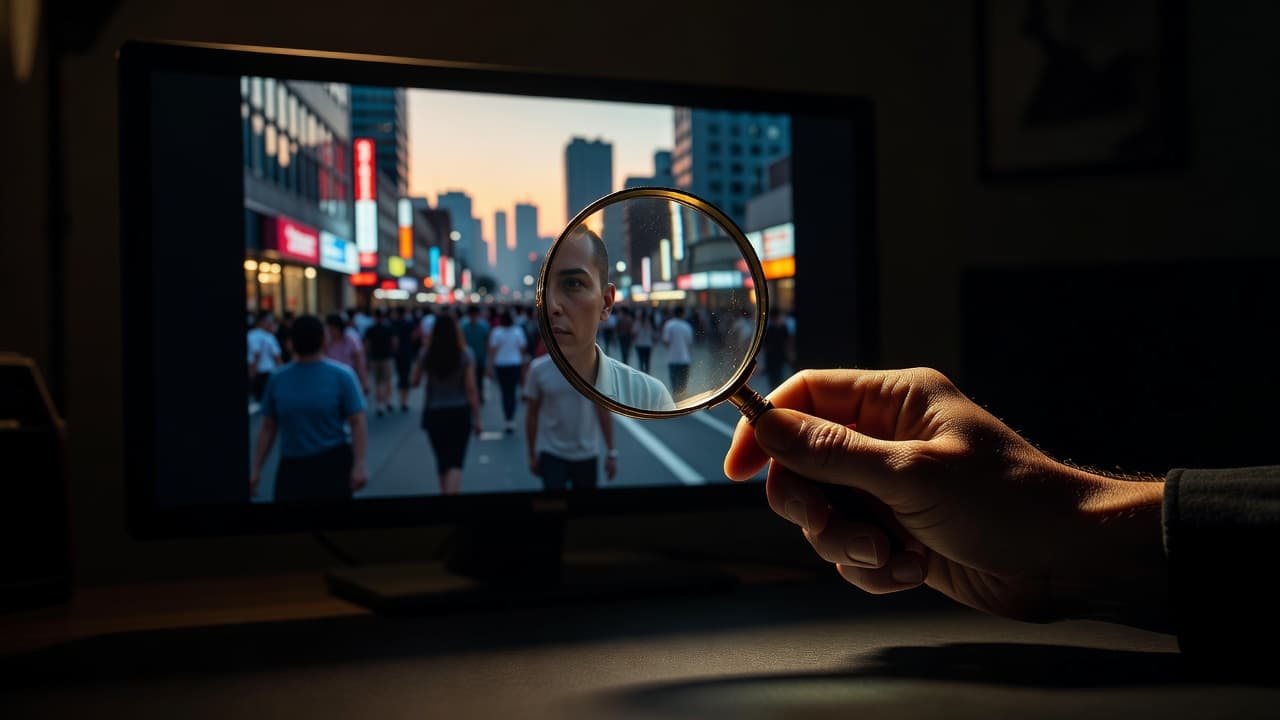
Illustration, AI-generated. It is not a real news photograph.
These signs are useful for triage. They tell us where to investigate, but they do not provide a final verdict on whether the media is authentic.
The Global Investigative Journalism Network's guide to detecting AI-generated content covers additional forensic clues, including unusual pixel patterns and duplicated image regions. We should treat those methods as evidence-gathering tools, not automatic judgments.
Separate AI Images From Edited or Misleading Photos
Not every false news image is AI-generated. That distinction changes the investigation.
A fully synthetic image is created by a generative system. No camera captured the scene as shown. This synthetic media represents a complete departure from reality. An edited image begins with a real photograph but may include retouching, cropping, object removal, face replacement, or compositing. An out-of-context image is real, yet attached to the wrong date, location, event, or claim.
These categories often get mixed together. A real protest photo from 2019 may be shared as evidence of an event in 2026. A genuine photograph may be cropped to remove an important detail. A news post may use AI-generated images without labeling them, while readers assume it shows a real person or event. Furthermore, bad actors frequently use these tools to create fake profile photos or facilitate identity fraud within news bots to amplify false narratives.
We should describe the problem accurately:
- AI-generated images means the visual content itself was produced by an image-generation system.
- AI-edited means a real image may have been changed with generative tools.
- Manipulated visual media means the image was altered, whether by AI or traditional software.
- Misleading context means the image may be authentic but the caption or claim is false.
That language protects accuracy. Calling a manipulated photograph AI-generated images without proof creates a new error while trying to correct the first one.
Our wider media checks also require attention to framing, bias, and selective presentation. Guidance on analyzing bias in news narratives is relevant here because a photograph can mislead through its caption, placement, and omission, even when no pixels were fabricated.
Check the File, Metadata, and Content Credentials
The image file often tells us more than a screenshot. When possible, we obtain the original file from the photographer, newsroom, wire service, or the person who first posted it to verify image authenticity.
We inspect available metadata for camera make, lens, exposure, date, location, and editing history. A normal camera file may contain some of this information. A screenshot, social media download, or re-saved copy may contain little or none.
Missing metadata is a yellow flag, not proof of AI generation. Platforms often strip metadata during upload. Messaging apps and screenshots can remove it too. A real photograph may arrive without any useful technical record.
Content Credentials and C2PA-compatible systems offer another path to establish trust and safety in digital media. These credentials can record how a file was created or edited, along with a chain of changes. A valid credential can support provenance when the signature remains intact.
C2PA data still has limits. It can help establish a file's history, but it does not prove that the scene is accurately captioned. A real photograph with valid credentials can still be posted with the wrong date. Conversely, AI-generated images can also circulate after their provenance information has been removed.
We should record what we find rather than overstate it:
- The file contains camera metadata consistent with the claimed source.
- The file has a valid content credential showing generative editing.
- The available copy contains no metadata.
- The file has been re-compressed or captured from a screen.
- The source has not provided the original file.
That is stronger reporting than writing that the image is fake simply because it lacks metadata.
Trace the Image Back to Its First Known Source
Reverse image search is one of the fastest ways to test a news image. We use Google Lens, Google Images, TinEye, and Yandex Image Search. Each service has different coverage, so one search is not enough.
We begin with the full image, then crop the key subject, logo, building, or unusual background. Cropping can expose earlier versions that a full-image search misses. We compare dates, captions, image dimensions, and account histories.
The first result isn't always the original. Search engines often rank the most popular copy instead of the earliest publication. A repost may appear above a photographer's account or a local news report. Sometimes, you might find that AI-generated images have been lifted from marketplace listings or public forums to lend a false sense of legitimacy to a post.
We ask several direct questions:
- Where did the image first appear?
- Was the first account connected to the claimed event?
- Does the earliest caption match the current claim?
- Do weather, clothing, signs, and architecture fit the location?
- Are other photographs available from the same event?
- Has a photographer, agency, government office, or witness provided the original?
A major event may produce multiple independent images, video clips, eyewitness accounts, or official records. If a dramatic claim appears only in one anonymous post, we slow down. That absence isn't conclusive, especially for local or private events, but it raises the reporting burden.
We also check credible coverage without treating any one outlet as a final authority. A useful fact-checking guide for news, media, and AI content includes reverse search methods and notes that Google tools may identify content credentials connected to Google's AI systems.
Context often settles what visual inspection cannot. A real photograph from a flood may be mislabeled as a current hurricane. A genuine image from one country may be presented as evidence from another. The image is real. The news post is still false.
Use AI Detectors as Supporting Evidence
An AI photo checker or an AI art detector can estimate whether a file resembles generated content. These tools rely on machine learning algorithms to perform a pixel-level analysis, examining subtle patterns in texture, compression, and visual regularity that are often invisible to the naked eye. While these programs are useful for deepfake detection, their results are never conclusive.
These tools provide a confidence score rather than a definitive answer. Different detectors often disagree on the same file, and factors like compression, resizing, filters, or older editing software can frequently lead to false positives. Conversely, a detector might fail to flag a synthetic image if it has been heavily cropped or reposted multiple times.
We use detector results strictly as a lead. A high probability of AI generation should prompt us to dig deeper into the source, file history, and reverse search. It should never serve as the primary evidence for a headline. The same rule applies when a detector suggests an image is likely real; that result does not verify the caption, location, date, or the identity of the people shown.
Research guides such as VCU's AI fact-checking resource recommend tracing claims to reliable sources instead of accepting automated results as proof. That principle applies to imagery as much as text. Ultimately, these tools should support, not replace, human judgment. When evidence conflicts, we state that conflict clearly. Saying one detector flagged the file, but no visual or source evidence confirms generation, is honest. Conversely, claiming an AI detector proves the photo is fake is misleading.
Build a Repeatable Verification Workflow
Newsrooms and social teams need a process that works under pressure. For high-volume verification tasks, many content moderation departments now rely on API integration to streamline the initial analysis of incoming media. We suggest using this order:
- Preserve the evidence. Save the image, caption, account name, post URL, timestamp, and any visible edits before the post changes.
- Inspect the image. Zoom into hands, text, reflections, shadows, faces, repeated patterns, and background objects.
- Classify the claim. Decide whether we are testing a synthetic image, an edited photograph, or a real image used out of context.
- Search for earlier versions. Use multiple reverse image tools and several crops.
- Request the original. Ask for the camera file, photographer credit, agency record, or content credentials.
- Check the event. Compare location, weather, time, witnesses, official records, and independent reporting.
- Use detection tools last. Add their results to the evidence record, without treating them as a verdict.
- Label uncertainty. Publish what is confirmed, what is disputed, and what remains unknown.
If we publish an illustrative image made with AI, the label must be visible and direct: "AI-generated illustration. Not a real photograph." We do not place AI-generated images beside a breaking-news claim without that warning. Proper labeling also reinforces editorial standards and helps maintain transparency regarding copyright protection.
A correction should also be clear. If an image was miscaptioned rather than fabricated, we say so. If new evidence changes the assessment, we update the post and preserve the correction history.
Frequently Asked Questions
Are distorted hands or fingers a definitive sign that an image is AI-generated?
No, visual oddities like strange fingers or blurred text are only indicators, not final proof of manipulation. While early AI models often struggled with these details, newer systems are becoming increasingly adept at hiding such flaws, meaning visual inspection alone is no longer a reliable verification method.
Is a lack of metadata proof that an image is fake?
Missing metadata is not confirmation that an image has been fabricated or generated by AI. Digital platforms, messaging apps, and simple screenshots often strip technical data during the upload or sharing process, meaning a perfectly authentic photograph can arrive without any supporting metadata.
Should I trust AI detection software to verify an image?
AI detectors should only be used as a supplementary tool to guide further investigation rather than as a final verdict. These programs often produce false positives or conflicting results, and they should never replace rigorous human research into an image’s source, file history, and contextual evidence.
How should we label AI-generated images in news content?
If an AI-generated image is used as an illustration, it must include a clear, direct label such as "AI-generated illustration. Not a real photograph." Never use AI-generated visuals alongside breaking news claims without these warnings, as this ensures editorial transparency and maintains reader trust.
Conclusion
The most effective way to detect AI images is not by relying on a single visual trick or an automated detector score. Instead, we combine careful visual analysis with provenance checks, reverse image searches, source verification, and event evidence.
A strange hand or distorted background may start the inquiry, but these visual oddities cannot finish it. We protect trust and safety in news reporting when we systematically separate synthetic media from edited or out-of-context photographs, label uncertainty plainly, and refuse to turn mere suspicion into verified proof. By building a repeatable workflow, we can better identify AI-generated images and uphold the standards of accuracy our readers deserve.