To verify the record, match the facility first, then trace its program, dates, and supporting records. A database flag is useful evidence, but its meaning depends on the program, dates, and later developments.
We treat facility identity as the first safeguard. A familiar company name can lead you to the wrong plant, an older address, or a different permit.
Start with the site itself, then follow the record far enough to support the claim you want to make.
What ECHO records can establish
EPA ECHO, or Enforcement and Compliance History Online, brings together environmental compliance and enforcement records reported by EPA and state, local, and tribal agencies. These records document a facility's environmental compliance history.
EPA's ECHO frequently asked questions describe coverage of more than one million regulated facilities nationwide. That broad coverage doesn't mean every environmental problem, inspection, or violation appears there.
Public searches require no login or API key. You can search for a facility, open its Detailed Facility Report, and examine available compliance information without registering.
The update schedule also matters. ECHO isn't uniformly updated daily. EPA says most data update weekly, while some programs follow different schedules. A newly reported incident can precede the database entry.
We use ECHO to establish what the public compliance history shows. A report may list reported violations, an inspection, or enforcement actions. It doesn't independently prove every claim about a company, and an empty result doesn't prove a clean record.
The record is a starting point with boundaries. Keep those boundaries attached to the finding.
Search for the facility and match its identity
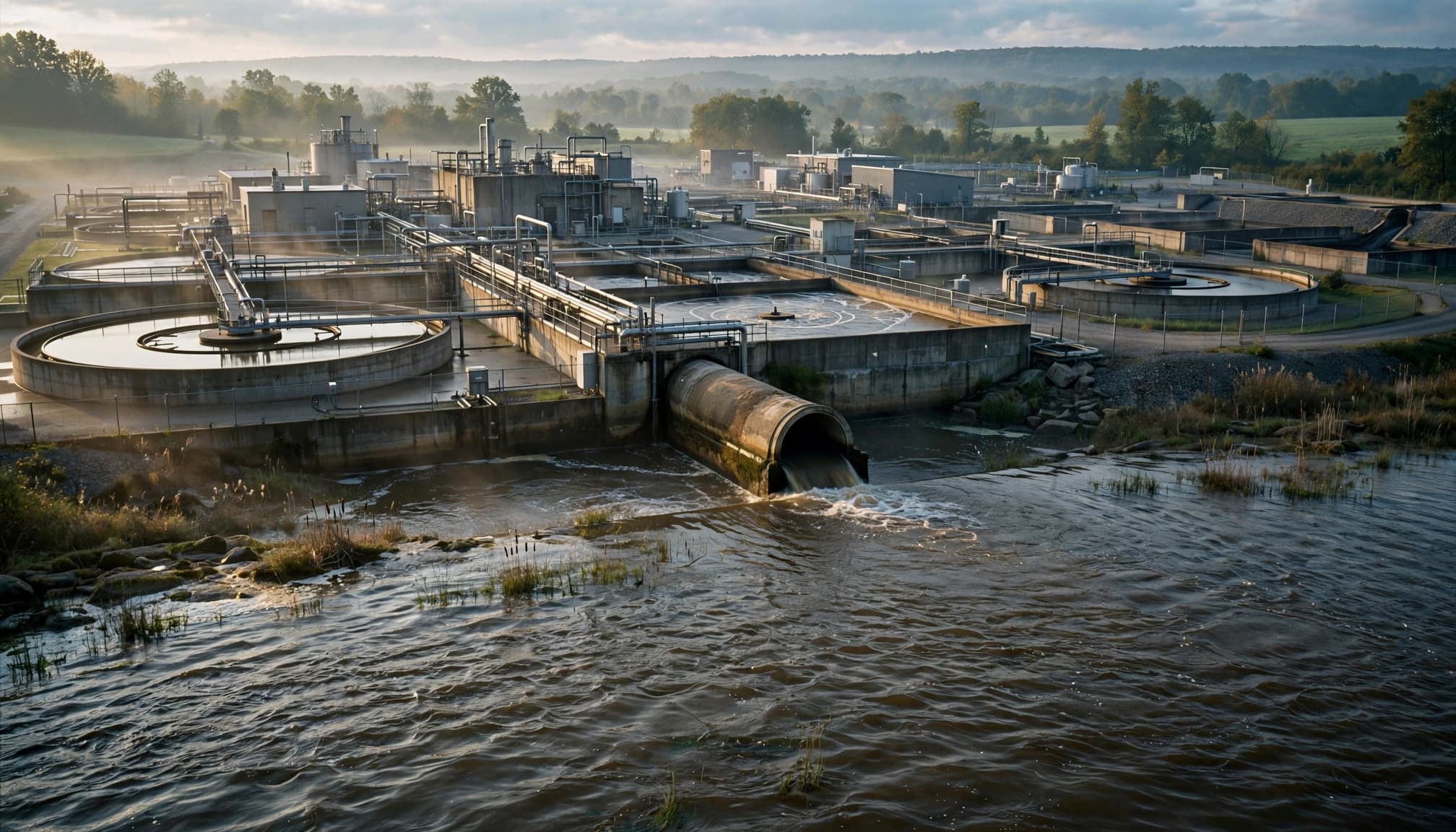
Illustrative industrial site, not a facility identified in an ECHO record.
Find a candidate record
Open EPA ECHO and choose All Media Programs in the facility search tool for a broad search. In the facility search, enter the facility name and its two-letter state abbreviation. If the facility search returns no results, try a distinctive part of the name or a former operating name.
You can narrow results by location, industry, and compliance criteria. A NAICS code has six digits and identifies an industry. Useful screening codes include 324110 for petroleum refineries, 325110 for petrochemical manufacturing, 211120 for crude petroleum extraction, and 562211 for hazardous waste treatment and disposal.
These NAICS classifications describe operations, not guilt. We wouldn't treat a NAICS code as evidence of a violation.
Leave filters for violations off during the identity search. An active filter can hide the site whose historical record you need.
Match the physical site and identifiers
Open the candidate's Detailed Facility Report. Compare the facility name, street address, city, and map location with the site under review. Check whether the record describes the plant rather than a corporate office.
Record the 12-digit EPA Facility Registry Service identifier, usually called the FRS ID or registry ID. FRS connects records associated with a facility across environmental programs.
Also preserve program identifiers, such as an NPDES permit number or RCRA ID. Compare the registry ID and program identifiers with the candidate record. One site can have multiple program records.
A matching company name isn't enough. The address and identifiers should support the same facility.
How to read EPA ECHO violations by program
EPA programs measure different things and use different reporting periods. Water compliance quarters, hazardous waste findings, and air enforcement actions aren't interchangeable measures.
The following fields need different interpretations.
| Field | What it describes | Main caution |
|---|---|---|
DrCWVio | CWA quarters with violations within a three-year window | Don't treat every quarter with a finding as SNC. |
DrRCRAVio | RCRA quarters with findings within a three-year window | A quarter count isn't a count of separate incidents. |
DrCAAAcc | Formal Clean Air Act enforcement actions | An action isn't automatically a final judgment. |
TRIReleasesLbs | Reported annual TRI releases in pounds | A release quantity isn't a finding of noncompliance. |
We keep the displayed labels and reporting periods with these values. EPA's Detailed Facility Report data dictionary explains the underlying report categories.
Clean Water Act findings and SNC
The National Pollutant Discharge Elimination System, or NPDES, regulates permitted wastewater discharges under the Clean Water Act.
Significant Non-Compliance, or SNC, is a defined status for qualifying serious compliance problems under the Clean Water Act. These can involve discharge limits, missing reports, or other requirements.
DrCWVio counts quarters with findings, not just Significant Non-Compliance quarters. Read the separate SNC status and permit details before calling a facility significantly noncompliant.
Several quarters with findings can reflect one continuing problem. They don't necessarily describe separate pollution events.
RCRA hazardous waste findings
RCRA regulates hazardous waste handling and management. RCRA violations can involve missing hazardous waste manifests, improper labeling, unauthorized disposal, or failure to meet accumulation requirements.
The familiar 90-day accumulation limit applies to qualifying large quantity generators operating under specified conditions. It isn't a universal deadline for every hazardous waste generator.
Read the hazardous waste finding description and facility classification together. A summary count won't tell you which requirement applied or whether the agency later recorded compliance.
Separate air enforcement from TRI reporting
Clean Air Act formal actions
Formal enforcement under the Clean Air Act can include compliance orders, administrative penalty proceedings, and judicial actions. In EPA ECHO, a judicial referral can precede litigation, but it doesn't establish the court's final decision.
The DrCAAAcc field concerns formal enforcement activity under the Clean Air Act. It isn't a count of inspections, emissions exceedances, or convictions.
Read each Clean Air Act action separately from its outcome. An order can require corrective work, a complaint can allege violations, and a settlement can resolve a case under terms that need their own review.
Check the action date, case status, and associated documents to understand what the enforcement actions establish.
TRI releases aren’t automatic violations
The Toxic Release Inventory tracks annual reporting of listed toxic chemicals by covered facilities that meet applicable criteria and thresholds.
Coverage depends on listed substances, facility status, activities, and thresholds. The Toxic Release Inventory is separate from hazardous waste requirements and doesn't cover every chemical used at every business.
TRIReleasesLbs reports TRI releases in pounds for a reporting year. Keep the year attached to the amount, since TRI releases aren't hazardous waste totals.
A reported release can be permitted. A large total can justify further review, but it doesn't alone establish illegal pollution, exposure, or health harm. Read the chemical-specific information before making a broader claim.
Check dates, source records, and inspection details

The supporting documents can explain details a summary entry leaves out.
Build the timeline before describing current status
Compare the violation period, dates of inspections, enforcement actions, and the latest status information. These dates answer different questions.
A facility can have historical violations while showing no current violation flag. It can also have an unresolved enforcement case concerning an earlier period.
EPA's explanation of ECHO data sources identifies source systems and refresh information. A recent database refresh doesn't mean every underlying event was recently entered.
We keep the access date separate from the event date. "Viewed today" doesn't mean "occurred today."
Read what the inspection actually found
Within the facility report, review records for inspections, compliance monitoring, violation details, and enforcement. Look for the responsible agency, program identifier, violation description, and any available return-to-compliance information.
For a program such as the Clean Water Act, locate the underlying inspection report, notice, order, or permit record. An entry in the inspections section confirms that monitoring activity occurred, but it doesn't establish what inspectors found.
Missing information may require confirmation from the responsible agency. State-managed records can contain details that haven't reached ECHO or aren't reproduced there.
If records conflict, compare their dates and versions. Report the disagreement rather than choosing the entry that supports the expected conclusion.
Distinguish allegations, case outcomes, and penalties
Read the enforcement case through its outcome
ECHO's Enforcement Case Search provides a route for reviewing civil and concluded criminal enforcement records. Search by facility name, location, and available case identifiers. For a Clean Water Act case, check the program and facility details against the record.
Keep three stages separate: a reported violation, a formal enforcement action, and the legal outcome. A database entry listing violations isn't automatically a final judicial finding.
A complaint states allegations. Administrative and compliance orders can establish obligations, while a final court decision can establish findings within its scope. A settlement may resolve claims without admitting every allegation.
For penalty reporting, read the final order, consent decree, or settlement terms. Don't merge a proposed penalty, an assessed penalty, and money actually paid.
Case-wide totals can also cover multiple facilities. Attribute the amount only as narrowly as the document supports.
Use the right route for a new concern
ECHO's Help resources include Report A Violation for submitting information about a potential environmental concern, and Enforcement Case Search for reviewing recorded cases.
A complaint should describe the location, date, observed activity, and supporting evidence. Separate what you saw from what you infer.
For an incorrect database entry, use Report a Data Error rather than treating the entry itself as a new pollution complaint.
We wouldn't infer a reporter reward from the complaint route. Reporting a concern and qualifying for any separate statutory reward are different matters.
Preserve a finding someone else can retrace
A sound finding needs more than a screenshot of a colored status box. Save the facility report, downloaded results, relevant agency documents, and an Enforcement Case Search result when case context matters. EPA's ECHO data downloads support broader analysis when a single-site search isn't enough.
Record the search criteria, access date, FRS ID, registry ID, NAICS code, program identifiers, reporting periods, and document versions. For PDFs, preserve the page reference and surrounding text.
If the underlying federal record isn't publicly posted, our guidance on filing a FOIA request explains how to request it. State records generally require the applicable state public-records process.
This discipline matters when reviewing a facility's compliance history for merger due diligence, lender screening, real estate review, and investigative journalism. Any ranking based on violations needs a defined program, period, and counting method.
Our approach to checking original data sources applies here: trace the figure to its definition before comparing it.
Repeated news coverage isn't independent confirmation when every story relies on the same database entry.
Key takeaways for a facility records check
- Match the name, physical address, FRS ID, and program identifiers before attributing a record.
- Keep violation quarters, enforcement actions, and annual TRI releases in their own categories.
- Attach dates and reporting periods to every claim about current or historical compliance.
- Read supporting agency documents before describing allegations as final findings or proposed penalties as paid amounts.
Frequently Asked Questions
What does an EPA ECHO violation record show?
ECHO brings together compliance and enforcement records reported by EPA and state, local, and tribal agencies. A record documents public compliance history, but it doesn't independently prove every claim about a company, and an empty result doesn't prove a clean record.
How can I confirm an ECHO record belongs to a facility?
Compare the physical address and map location with the facility, then check its FRS ID and program identifiers. A matching company name alone isn't enough.
Does a Clean Water Act violation quarter mean a separate pollution event?
DrCWVio counts quarters with findings within a three-year window, not separate incidents or only Significant Non-Compliance quarters. Several quarters can reflect one continuing problem.
Do TRI releases prove a violation?
TRIReleasesLbs reports annual TRI releases in pounds for a reporting year. A reported release can be permitted, and the amount alone doesn't establish illegal pollution, exposure, or health harm.
Keep the claim within the record
EPA ECHO violations become more useful when the facility, program, period, and legal status stay visible. We can report what the database shows without giving a summary field more authority than it has.
The strongest finding leaves a traceable record. It identifies the site, names the supporting documents, and states where the evidence stops. That lets another reader follow the same trail and assess the conclusion.