
FDA approval and FDA clearance are different regulatory decisions. Approval usually follows a review of a higher-risk device; clearance usually means FDA found it comparable to a legally marketed device.
When we compare FDA approved vs cleared claims, we look for the decision behind the wording. A seller's FDA cleared claim should match the official decision and its scope; neither decision guarantees a device will work for every patient.
The useful starting point is the official record, followed by the device, model, and use that record actually covers.
Key Takeaways
- FDA approval usually follows a PMA review for a high-risk device. FDA clearance usually follows a 510(k) review that finds a device substantially equivalent to a legally marketed predicate.
- Check the official decision record and compare its manufacturer, model, intended use, and indications with the product claim.
- Registration and device listing don't mean FDA approved or cleared a product, and "FDA compliant" isn't a marketing authorization.
- A missing record in one database doesn't prove a product is unauthorized. Check for exemptions, other pathways, and later safety information.
FDA approved vs cleared: What each decision means
The terms describe different review pathways. They aren't interchangeable, and neither guarantees that a device will work for every patient.
Approval requires a PMA review
A PMA, or premarket approval, generally applies to high-risk Class III devices. FDA requires valid scientific evidence that provides reasonable assurance of safety and effectiveness for the device's intended use.
That evidence usually includes clinical investigations, alongside manufacturing information and other testing. The finding applies to the uses and conditions described in the approval. It doesn't support every claim a seller might attach afterward.
Clearance compares a device with a predicate
A 510(k), called a premarket notification, generally supports clearance. The manufacturer must demonstrate substantial equivalence to a legally marketed predicate device.
The comparison addresses intended use, technology, and safety and effectiveness. Different technology can qualify when it doesn't raise different safety or effectiveness questions and supporting evidence is adequate.
FDA's overview of approvals and clearances separates these pathways.
| Question | 510(k) clearance | PMA approval |
|---|---|---|
| Common device class | Most nonexempt Class II devices | Most Class III devices |
| Central finding | Substantial equivalence to a predicate | Reasonable assurance of safety and effectiveness |
| Evidence | Appropriate testing, sometimes clinical data | Valid scientific evidence, usually including clinical investigations |
| Review clock | Generally a 90-FDA-day goal | A statutory 180-day review period |
These clocks aren't guaranteed delivery dates. Requests for additional information and other review steps can extend elapsed time.
Device classes describe risk and required controls
FDA groups generic medical device types into medical-specialty panels. Three risk classes determine the controls devices generally need.
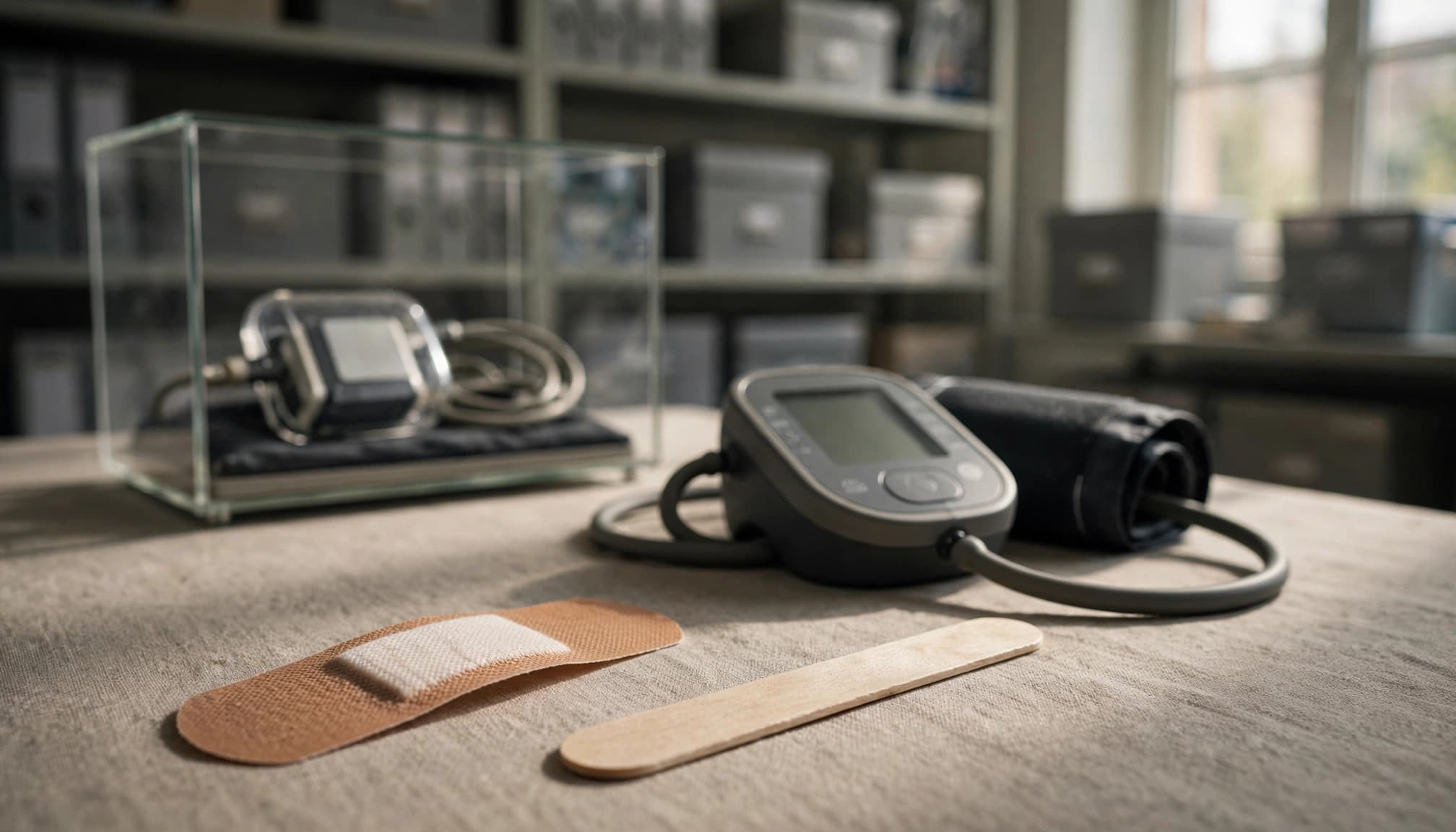
Class I devices present the lowest risk. Examples include tongue depressors, adhesive bandages, and elastic bandages. Many Class I device types are exempt from premarket notification.
Exempt devices are still subject to other requirements, which can include labeling, registration, listing, and applicable quality-system requirements.
Class II devices present moderate risk and generally require additional controls. Examples include powered wheelchairs, infusion pumps, pregnancy tests, and blood pressure monitors. Most require 510(k) clearance, although exemptions exist.
Class III devices present the highest risk. They often support or sustain life, or pose a potentially unreasonable risk of illness or injury. Pacemakers, replacement heart valves, and breast implants are familiar examples. Most require the agency's most demanding premarket review.
A device's intended use matters alongside its hardware. Its appearance alone can't establish its classification.
Registration and listing don’t mean approval
Establishment registration identifies businesses involved in medical-device activities. Device listing identifies the devices associated with those activities.
Manufacturers, initial importers, and certain other establishments must register. Requirements depend on what the business does; not every distributor has the same obligations.
A registration or listing doesn't establish that a product is FDA approved or FDA cleared. Neither is an FDA approval or FDA clearance decision, or proof that FDA reviewed the medical device.
We apply the same distinction in public-records research: a genuine record can prove less than the claim attached to it.
"FDA compliant" also isn't a marketing authorization. Without an identified requirement and supporting evidence, the phrase leaves the central question unanswered.
Search the FDA record, not just the product name
A useful search starts with identifiers, not a badge copied onto a sales page. The FDA's medical-device database directory provides access to the main record systems.

Choose the database that matches the claim
Use the 510(k) database for a clearance claim. It contains premarket notification records. For an approval claim, search the FDA database that records approval decisions.
A practical sequence is:
- Search the submission number if one is supplied.
- Without a number, search the applicant or manufacturer, then the regulatory device name or product code.
- Open the decision record and available documents, rather than stopping at the search-result title.
The database includes fields for applicant, device name, product code, and submission number. Changing one field at a time makes mismatches easier to spot.
Follow identifiers when names don’t match
A device may appear under its regulatory name, an original manufacturer's name, or a company name that predates an acquisition. A private-label product may carry a different retail brand.
Compare the label's manufacturer, model, and identifiers with the record. A similar name alone isn't enough.
A 510(k) number begins with K followed by six digits. The first two digits generally identify the submission year, not the clearance year. The remaining digits identify the submission sequence.
A real submission number proves that a record exists. The model and indications determine whether that record supports the product claim.
Read the decision’s scope before accepting the claim
Finding a matching record is the beginning of the comparison. The next question is what FDA actually allowed.
Match the model to the documented use
Compare the seller's claim with the decision documents and labeling. Check model numbers, accessories, patient populations, prescription restrictions, and where the device may be used.
"Intended use" describes the device's general purpose. "Indications for use" describe the disease or condition, target population, and circumstances covered by that purpose.
A clearance for one condition doesn't establish clearance for another. A record covering professional use doesn't automatically support unsupervised home use.
We look for agreement between the advertised use and the documented use, rather than treating a database match as blanket permission.
Read the evidence behind substantial equivalence
FDA clearance is based on a comparative review. It doesn't independently prove every advertised benefit or show that each claim was clinically tested.
The 510(k) submission requirements require evidence supporting substantial equivalence. The decision doesn't establish safety and effectiveness beyond its documented scope.
Not every cleared device undergoes clinical trials. Depending on the device, evidence may include bench testing, electrical safety testing, software validation, biocompatibility testing, or clinical data.
When available, the 510(k) summary helps show what was tested and which predicate supported the decision. Marketing language can exceed the scope of the decision and its supporting documents.
Check safety history without flattening the numbers
An authorization record captures a regulatory decision. Later safety information can change the picture.
Search FDA's recall database and safety communications using the manufacturer, device name, and model. Read the affected lots or serial numbers, the reason for the action, and the recommended response.
Recall classifications describe the seriousness of a recall. They are separate from the risk-based classes assigned to device types.
FDA's predicate-removal figures track eligibility for future submissions, not every recalled device.
A 510(k) submission's page count alone doesn't establish evidence quality.
Any annual recall-rate figure for 510(k) devices is a system-level measure. It doesn't establish an individual device's safety, even for devices with a Class I or Class II recall.
FDA can reclassify a device type from Class II to a higher-risk category and require PMA when available evidence and controls don't adequately assure safety and effectiveness.
Other pathways can explain a missing record
A missing record in one FDA database doesn't prove a product is unauthorized or confirm its authorization. Some devices are exempt, while others use a different pathway.
The De Novo pathway classifies certain novel, low- or moderate-risk devices when no suitable comparison exists. Emergency Use Authorization, or EUA, permits specified uses during an emergency. An EUA isn't ordinary clearance or approval.
The Humanitarian Device Exemption pathway covers eligible devices for conditions affecting fewer than 8,000 people in the United States each year. HDE approval is exempt from the PMA effectiveness requirement. FDA weighs probable benefit against risk, along with other requirements.
For classification questions, FDA's Product Classification database identifies device types, classes, and applicable requirements. Manufacturers can submit a Section 513(g) request to seek FDA's formal views on classification and regulatory requirements. The request isn't routinely required, and it isn't permission to market.
If it's unclear whether a product qualifies as a medical device, FDA also accepts requests for a device determination.
Frequently Asked Questions
What’s the difference between FDA approved and FDA cleared?
Approval generally follows a PMA review and requires reasonable assurance of safety and effectiveness for the device's intended use. Clearance generally follows a 510(k) review that finds the device substantially equivalent to a legally marketed predicate.
How can I check an FDA approval or clearance claim?
Search the database that matches the claim, using a submission number when available or the manufacturer, device name, or product code. Compare the record and its documents with the exact model and use described in the claim.
Does FDA clearance prove that every advertised benefit was clinically tested?
No. Evidence for a 510(k) can include bench, electrical safety, software, or biocompatibility testing, as well as clinical data, depending on the device. Clearance doesn't independently prove every advertised benefit or extend beyond the decision's documented scope.
Do FDA registration and device listing mean a product is approved or cleared?
No. Registration identifies certain businesses involved in medical-device activities, and listing identifies devices associated with those activities. Neither is an FDA approval or clearance decision.
Does a missing record in an FDA database mean a product is unauthorized?
No. A device may be exempt or use a different pathway, such as De Novo or Emergency Use Authorization. Check the pathway that applies to the device before drawing a conclusion.
Follow the claim to the decision
FDA approval, clearance, and registration describe different regulatory findings, so they don't mean the same thing.
We judge a device claim by its matching record and documented scope, then consider later safety information. The strongest support connects the exact device, its authorized use, and the evidence behind the decision.
A familiar label can start that search. It can't finish it.