
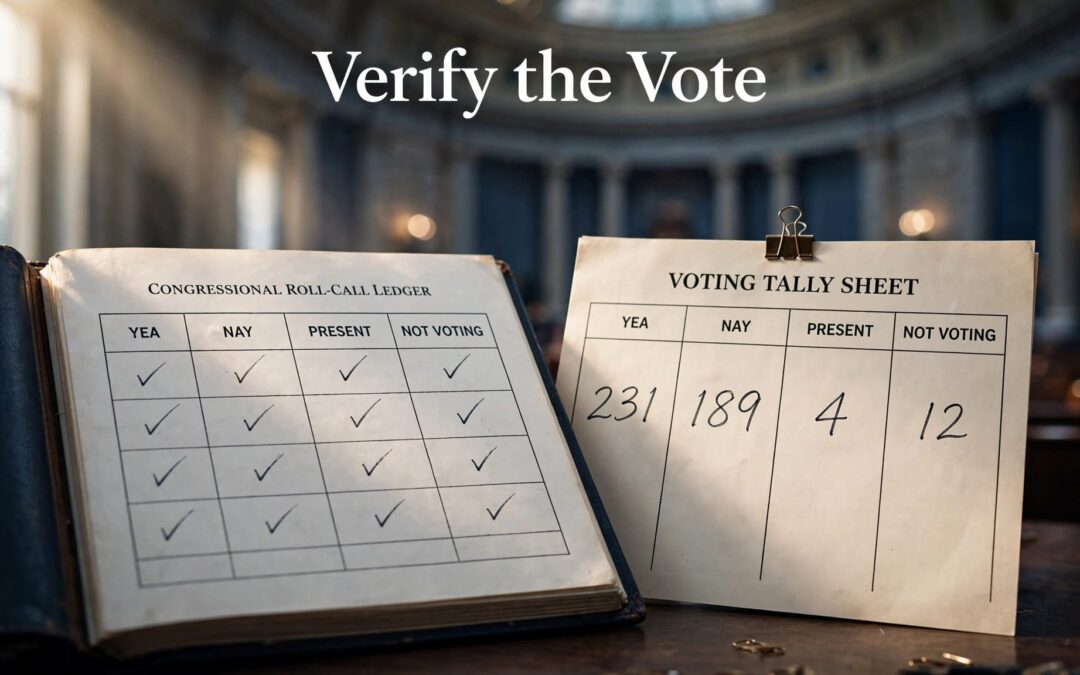
To verify congressional roll-call votes, start with the official House or Senate record, then compare its totals with its member-by-member entries. The numbers need to match the exact question voted on, because passage, amendments, and procedural motions establish different things.
A headline can preserve the tally while losing that distinction. At AAIM, we recommend keeping the chamber, date, vote number, and question attached to every finding.
Start by locating the record behind the claim, rather than treating a screenshot or summary as the complete account.
Key takeaways
- Use the House Clerk or Senate vote record as the primary source for totals and individual votes.
- Match the Congress, session, chamber, and roll-call number before comparing figures.
- Keep yea, nay, present, and not-voting categories separate. Their presentation differs by chamber.
- Cross-check Congress.gov and news summaries against the same recorded question.
- Treat a missing entry or conflicting number as a question to resolve, not automatic evidence of an error.
Start with the official chamber record
A useful summary points toward the evidence. The chamber record supplies the question, the recorded positions, and the published result.

Find House votes through the Clerk
The House Clerk's roll-call records provide vote listings and individual records. Locate the relevant year, then narrow the search using the date, measure number, or roll-call number.
Open the individual vote rather than relying on the listing alone. Read its question, vote type, result, category totals, and member entries.
A bill number helps locate the record, but it doesn't identify one vote. The same measure can produce several roll calls on amendments, procedural motions, and passage. A search result that names the right bill can still point to the wrong decision.
Find Senate votes through Senate.gov
The Senate's official vote pages organize roll calls by Congress and session. Individual records identify the question, result, totals, and senators' recorded votes.
Senate business includes legislation and nominations. For a nomination, retain the nomination identifier as well as the person's name and office.
Our guidance on finding original data sources follows the same principle: choose the record suited to the claim. For an individual senator's recorded position, the member-level entry matters. A general account of the day's proceedings answers a broader question.
Match the identity and question before counting
Two accurate totals can appear to conflict because they describe different votes. Establish the identity of the record before comparing its numbers.
Keep the Congress and session attached
The 119th Congress covers 2025 and 2026. Its first session corresponds to 2025, and its second session corresponds to 2026.
Bill numbers recur across Congresses. Roll-call numbers also need their chamber and session context. "Vote 314" alone isn't a dependable citation.
Record the chamber, Congress, session, date, roll-call number, and measure or nomination identifier. Together, these details distinguish one decision from nearby decisions.
Congress.gov's House vote search guidance identifies fields including the vote number, question, type, and result. Those fields provide a practical framework for matching records.
Read what a yes vote meant
The question determines what the tally establishes. A vote on an amendment concerns that amendment. A motion to proceed concerns taking up business. Passage concerns the measure identified in that question.
For nominations, cloture concerns ending or limiting debate under Senate procedures. A successful cloture vote doesn't establish confirmation.
That matters when a headline says a nominee "cleared a Senate vote." The phrase may describe a procedural step accurately while leaving the final outcome unstated.
We recommend reporting the formal question alongside any plain-language explanation. That keeps an interpretation from traveling farther than the record supports.
Reconcile the categories in congressional roll-call votes
Counting requires consistent categories. A summary showing only support and opposition may leave out entries that the chamber publishes separately.
Add the categories without changing their meaning
House records commonly display yea, nay, present, and not voting. Senate records generally display yea, nay, and not voting. Preserve the labels used by the particular record.
The Clerk's September 16, 2026 listing for House Roll Call 314 on S. 2403 illustrates the distinction:
| Recorded category | Total |
|---|---|
| Yea | 401 |
| Nay | 14 |
| Present | 0 |
| Not voting | 18 |
These categories total 433. The yea and nay categories total 415. Both calculations are correct, but they describe different quantities.
For an independent recount, count each member-level entry under its published category, then compare those counts with the header totals. If you're using a spreadsheet, retain the original labels rather than merging categories.
Separate arithmetic from the passage threshold
The September 16 question was "On Motion to Suspend the Rules and Pass." That wording belongs with the figures.
A valid arithmetic total doesn't establish whether a motion passed. The applicable threshold matters too. House suspension motions require a two-thirds vote of members voting, with a quorum present. Other questions follow different rules.
Use the record's vote type, required majority where displayed, and published result. Don't apply a simple-majority assumption to every tally.
Also avoid forcing every House record to total 435 or every Senate record to total 100. Vacancies and the membership applicable on that date affect the accounting.
Cross-check Congress.gov without flattening differences
Once the chamber record is identified, use Congress.gov's roll-call collection to locate the corresponding entry and related legislative information.

Compare the identifiers first. Then compare the question, result, and totals. A difference in wording can be harmless when one page abbreviates a question. A difference between an amendment vote and passage isn't harmless. It means the comparison concerns different decisions.
Next, open the measure's Actions section. This places the vote within the legislative sequence. It can reveal that a news report refers to an earlier motion, a later action, or the other chamber.
Congress.gov's bill summaries explain legislation. They aren't substitutes for member-level vote entries.
Source agreement also needs context. Congress.gov and a news report may both draw their numbers from the chamber record. Their agreement is useful, but it doesn't necessarily represent separate counting.
Our guide to comparing news reports makes the same distinction: several accounts can share one underlying source.
Keep the comparison like for like. A party subtotal, a yea-and-nay total, and a count including nonvoters answer different questions. If a summary supplies a percentage, identify its denominator before treating it as a conflicting figure.
A summary may also omit the question entirely. In that case, the matching total is only a partial match. The vote number and date still need to lead to the same recorded action.
Explain missing records and unresolved differences
An absent search result doesn't explain its own absence. A conflicting number doesn't explain its own cause. Both need a narrower comparison.
Distinguish coverage gaps from missing decisions
Congress.gov's detailed House vote pages begin with the 115th Congress, which started in January 2017. Its broader roll-call collection links to older chamber records. Searching the wrong collection can leave an available record out of view.
Use the guidance on House and Senate votes to distinguish the available records and routes into them.
Some actions also occur without an individual roll-call tally. Senate nominations, for example, can be confirmed by voice vote or unanimous consent.
For those actions, the nomination's dated action history and official floor proceedings establish what occurred. For a group action, establish that the particular nomination was included.
Describe a conflict before explaining it
When figures disagree, retain both versions and their source details. Compare their identifiers, categories, timestamps, and stated scope before attributing the mismatch to a correction.
A cropped screenshot may omit nonvoters. A search excerpt may preserve older wording. A copied figure may be wrong. Each explanation requires evidence.
Look for a dated correction or an official proceedings entry that addresses the difference. Don't label a changed display a changed vote unless the record supports that conclusion.
If the conflict remains unresolved, say which figures differ and which official record supports the reported total. Keep the uncertainty attached to that point. One unresolved mismatch doesn't establish that the entire vote record is unreliable.
Frequently asked questions
Does “not voting” mean a member opposed the measure?
No. "Not voting" records the absence of a yea or nay vote in that category. It doesn't establish opposition, support, or a reason for nonparticipation.
A member may separately explain an absence or state an intended position. Keep that statement separate from the recorded tally. The chamber's entry answers how the vote was recorded; the statement answers what the member later said about it.
What should a citation to a congressional vote include?
Include the chamber, Congress, session, date, roll-call number, exact question, and published totals. Link to the official vote record and retain a copy or dated capture for your reporting file.
When discussing one lawmaker, include the member-level entry. When discussing passage, include the vote type and result. When sources conflict, describe the unresolved difference rather than presenting one unexplained number as settled.
Keep the finding attached to the record
A dependable vote total needs an identifiable decision, consistent categories, and a traceable source. The arithmetic matters, but the question gives that arithmetic its meaning.
We recommend reporting what the record establishes, with its date and limits intact. That leaves readers with a finding they can follow back to the evidence.
A clean number is useful. A number attached to the right congressional action is stronger evidence.