
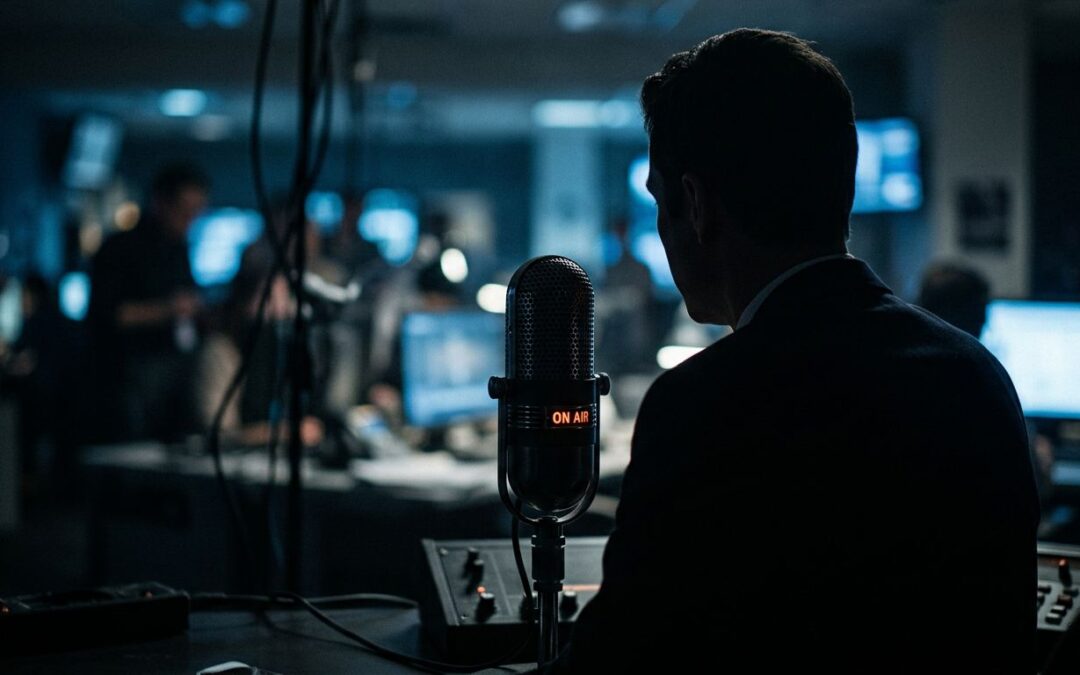
We naturally cultivate public trust when we can see who is speaking. We feel the floor shift when a report leans on anonymous sources and leaves us with a voice but no face.
That missing face matters more than most people think. It changes the tone of a story, the perceived size of a threat, and the space our minds fill in for ourselves. While journalism ethics provide the framework for these editorial choices, the way news media presents these accounts can be consequential. Some anonymous sourcing is necessary, even responsible, but vague attribution can turn concern into fear in a hurry.
Key Takeaways
- Anonymity and Fear: Anonymous sources remove the accountability of a named face, which can lead readers to fill in information gaps with their own worst-case scenarios, often inflating fear.
- The Dangers of Vagueness: The core issue is rarely the anonymity itself, but rather vague attribution that lacks concrete evidence, timelines, or context, allowing rumors to masquerade as established facts.
- Essential Standards: Legitimate anonymous sourcing is a vital tool for whistleblowers and protection; however, responsible journalism requires transparent editorial policies and clear explanations for why a source must remain hidden.
- Disciplined Reading: Consumers should practice media literacy by questioning the necessity of anonymity, looking for corroborating details, and remaining wary of stories that rely heavily on alarmist language without providing verifiable evidence.
Why unnamed sources feel more alarming
Names anchor a report and provide a foundation for journalistic credibility. They give us a place to stand while we sort out the facts.
When that anchor is gone, our brains start doing rough math. Who said it? Why hide their name? What do they know that we do not? That uncertainty can feel like danger, even before the facts are clear. Research on source cues in news judgment points in that direction. A review on fake news in ScienceDirect notes that people use source reliability as one of the primary signals when deciding whether a news report is believable. A separate piece on how anonymity changes behavior shows that hidden identity changes how people act. Readers feel that shift too.
Fear likes blanks. It grows in the space between something happened and the vague claims often made by unnamed sources.

The story may still be true, but the reader's reaction still changes.
That is why unnamed sources can feel heavier than named ones. A named source gives the reader a chain of accountability, while an anonymous individual offers only a claim and a shadow. If the claim involves war, crime, disease, corruption, or national security, the shadow does more work than the sentence itself. It hangs in the air.
How vague attribution turns concern into rumor
The danger is not only anonymity. The danger is vagueness.
If a report says "officials are worried" but offers no timeline, no evidence, and no concrete detail, the public does not hear caution. We hear warning. When news media outlets repeat the same unnamed claim, the rumor gains the shape of fact. By the third headline, the wording has already done its damage.
Uncertainty is not neutral. In news, it often behaves like fuel.
This is where fear spreads fastest. One outlet reports that "sources say" there may be a threat. Another repeats the line with a slightly stronger headline. Social media clips the most dramatic part and strips away the context. By morning, a weak claim feels like a settled event.
That pattern matters because news does not land in a vacuum. It lands in the average news consumer who is tired, overloaded, and primed to scan for risk. The APA has written about how media overload can strain mental health, and a recent paper on media-induced uncertainty and mental health links ordinary news exposure with stronger emotional strain. Fear rises faster when the message is unclear and the volume is high.
When organizations prioritize speed over rigorous information verification, the pressure gets worse. This highlights why high attribution standards are essential for maintaining public trust. Furthermore, media criticism regarding media narratives and cultural division is relevant here. Stories built on fear and faction rarely stay contained to the original issue. They spill into suspicion, blame, and tribal reading.
A report with no name can still be useful. A report with no anchor and repeated alarm bells is something else.
When anonymous sourcing is legitimate
Anonymous sources are not the problem by themselves. In investigative journalism, they are often the only safe way to bring critical truths to light.
Whistleblowers inside a hospital, government agency, or corporation may face severe retaliation for speaking out. A victim may require strict privacy for their protection, or a person with direct knowledge may only feel comfortable sharing information if their identity remains hidden. In these scenarios, confidential sources are essential tools that protect individuals while ensuring the public stays informed about important developments.
The line between responsible use and reckless use is not mysterious, though it is frequently ignored. Clear news gathering practices distinguish between high-quality reporting and sensationalism.
| Legitimate use | Risky use | What we should look for |
|---|---|---|
| Whistleblowers share sensitive documents due to fears of retaliation | A vague insider floats a provocative claim with no supporting proof | A clear, stated reason for anonymity |
| A victim or witness needs privacy | A reporter hides an identity just to add drama | Specific details that can be cross-checked |
| A public official provides information off the record that is later confirmed on the record | A source hints at a vague threat without providing context | Corroboration from other independent evidence |
A newsroom that employs anonymity effectively usually follows a transparent editorial policy. They explain why anonymity was necessary, clarify what the source could verify, and detail how the reporting was triple-checked. Conversely, a newsroom that uses anonymity poorly hides behind the vague label and moves on to the next story.
That distinction matters even more when ownership pressure and intense market competition reward heat over clarity. Corporate influence on news reporting can make speed look like a virtue, but speed is not the same thing as proof. When a report races to publish before it can fully explain itself, the unnamed quote becomes a shortcut. Ultimately, it is the readers who pay the price for that lack of rigor.
The words that quietly raise alarm
Fear is not only carried by the source. It is carried by the wording around the source.
Phrases like "people familiar with the matter," "a senior official said," or "sources warned" can sound careful, but they can also hide how thin the reporting is. While journalists often rely on official sources to protect sensitive information, this style of reporting can leave gaps in the narrative. A chain of verbs like "could," "may," "might," and "is believed to" adds to this uncertainty. Used once, those words show caution. Used over and over, they create a fog.
That fog matters because the reader is not hearing a legal brief. We are hearing a story about risk. If the story gives us no names, no documents, no on-the-record explanation, and no clear reason for caution, our minds fill the silence with worst-case possibilities. True media transparency requires that news outlets provide a shape the reader can hold, rather than leaving them to imagine the unknown.
A small wording shift can change the temperature of a paragraph. Compare these two approaches:
- "Officials say the situation is being monitored."
- "Officials say the situation is being monitored, but they would not explain what changed."
The second line is more concrete, and because of that, less scary in a cheap way. It provides a clearer picture, yet without independent corroboration, the reader is left questioning the veracity of the claim. The first line can leave us imagining whatever we fear most.
Repetition does the rest. Once a vague claim shows up in a headline, then a segment, then a post, the lack of detail starts to look like proof that something big is being hidden. That is how public fear grows without a single clear fact to support it.
How we can read without becoming cynical
We do not need to reject anonymous sourcing. We do need to read it with discipline.
- We should ask why the source needed protection.
- We should look for a second confirmation or a document.
- We should notice whether the reporter explains the limits of the claim.
- We should pause when a story has fear in the headline and thinness in the body.
- We should separate unverified from false.
The goal is not to distrust everything. The goal is to judge the quality of reporting practices. A careful article reflects sound journalism ethics by telling us what it knows, what it cannot yet prove, and why the source could not be named. A weak one will ask us to feel the danger before it shows us the evidence.
The APA's work on media overload and stress is a useful reminder here. Constant exposure to alarm can wear down our judgment. That makes a healthy reading habit matter for every news consumer. We need enough distance to think, but not so much cynicism that we dismiss real reporting when it arrives. By maintaining this balance, we can help protect public trust in the information we consume every day.
Frequently Asked Questions
Why do news outlets use anonymous sources if they make readers anxious?
Anonymous sources are often the only way for journalists to uncover critical truths, such as exposing government corruption or documenting workplace abuse where the whistleblower faces retaliation. While they can create uncertainty, they remain an essential tool for high-stakes investigative reporting when the information cannot be verified through on-the-record channels.
How can I tell if a story is using anonymity responsibly?
A responsible report will explicitly explain why the source needs protection and will provide as much context as possible to verify the claim. If the story relies on vague phrases like "people familiar with the matter" without offering supporting documents or corroboration, it may be prioritizing drama over evidence.
Does reading anonymous reporting mean I am being manipulated?
Not necessarily, but it does mean you are consuming information that has not been fully anchored to a specific, accountable individual. By recognizing that vague attribution can trigger an emotional response, you can maintain a critical distance and avoid letting the absence of a name dictate your sense of urgency or fear.
Conclusion
Anonymous sourcing shapes public fear because it changes the emotional math of a story. A named claim is easier to sort, question, and place, while an unnamed one can feel larger than it is, especially when sensitive information is shared on deep background.
This does not mean all anonymous sources are problematic. Rather, it underscores that context is essential. When we uphold a strict code of ethics, asking why a source is hidden and whether the reporting provides verifiable detail, we fulfill the critical watchdog mission of the press. By holding reporters accountable to these standards, we lower the chance that fear will do the thinking for us.
The missing name is not the only issue. The real challenge arises when vague attribution is used to inflate a story with alarm rather than verifiable evidence. Ultimately, readers must remain discerning, balancing the news value of a report against the transparency of its sources.